Chargement de la page…
Buying in Great Britain to resell in the European Union is an import, not a simple intra-EU purchase. Before comparing prices, identify the importer, the commodity code, any preferential origin, the customs value, the declarations, import VAT, product checks and the carrier's fees. The EU-UK agreement may allow preferential treatment only when the rules of origin are met and proven; goods shipped from the UK are not automatically of UK origin. Calculate the landed cost from actual documentation and block any opportunity whose classification, origin or contractual responsibilities remain ambiguous. This article covers flows with Great Britain; Northern Ireland requires a separate analysis.
Brexit adds a documentary border
The European Commission notes that customs declarations are required for goods imported from or exported to Great Britain, and that VAT rules differ from intra-EU transactions. The UK government states that businesses established in the EU should check with the customs authority of the importing country for the applicable procedures.
The supplier's price is therefore no longer enough. You need to know the Incoterms or, more generally, the contractual allocation of responsibilities: who arranges transport, who exports, who imports, who supplies the evidence, and who pays each cost. A commercial phrase like "delivery included" doesn't always answer these questions.
Preferential duty rates require compliant proof of origin. GOV.UK states that rules of origin determine whether a product can benefit from the treatment set out in the agreement. They rely on classification and on product-specific rules. Place of purchase, country of shipment and customs origin are three distinct concepts.
The calculation file to require
| Item | Question | Document or source |
|---|---|---|
| product | what composition and use? | manufacturer spec sheet |
| classification | which commodity code applies? | tariff tool and customs validation |
| origin | does the product meet the specific rule? | acceptable declaration or proof |
| value | what basis is declared? | invoice and applicable adjustments |
| responsibilities | who is exporter and importer? | contract and delivery terms |
| duties and taxes | what amounts are due? | authority of the importing country |
| transport | what fees, lead times and surcharges? | carrier quote and invoice |
| compliance | can the product be placed on the EU market? | suitable regulatory documents |
Do not copy the code supplied by a seller without checking it. GOV.UK's guidance on commodity codes explains that these codes are used for declarations and to determine duties, import VAT and any applicable measures. Within the EU, use the tools and authorities competent for the import concerned.
Procedure before you order
1. Define the flow. Note the real country of departure, the point of entry into the EU, and the final destination. 2. Name the parties. Identify the exporter, importer, declarant and the party responsible for product compliance. 3. Classify the goods. Gather material, function, composition and packaging before looking up the code. 4. Verify origin. Read the specific rule and obtain proof before claiming a tariff preference. 5. Build the customs value. Use the applicable method and adjustments, with a professional if necessary. 6. Estimate duties and VAT. Check the official source of the importing country, with no generic rate. 7. Add operational costs. Brokerage, filing, transport, insurance, inspection, delay and prep must stay separate. 8. Validate compliance. Check marking, responsible operator, language, safety and the product's environmental obligations. 9. Test lead time and price. Calculate a downside scenario before payment. 10. Reconcile after import. Replace estimates with the declaration, the transport invoice and the cost actually paid.
The full Amazon landed cost can receive the final landed cost, but it does not itself calculate a customs classification. If the stock then goes on to multiple European countries, compare Pan-European FBA and EFN separately.
A hypothetical example with no invented duty
Suppose a fictional lot bought for 1,000 monetary units, with 120 in transport, 40 in brokerage and a duty amount D determined by the code and the origin. These values are for illustration and describe no real import. The cost before import VAT and other treatments equals 1,000 + 120 + 40 + D, provided these items match the basis and scope of the scenario.
Never replace D with zero just because the parcel comes from the UK. Enter "to confirm" until the preference and the proof of origin are established. Import VAT should stay on its own line: whether it's paid and potentially recoverable depends on the seller's situation and the applicable rules.
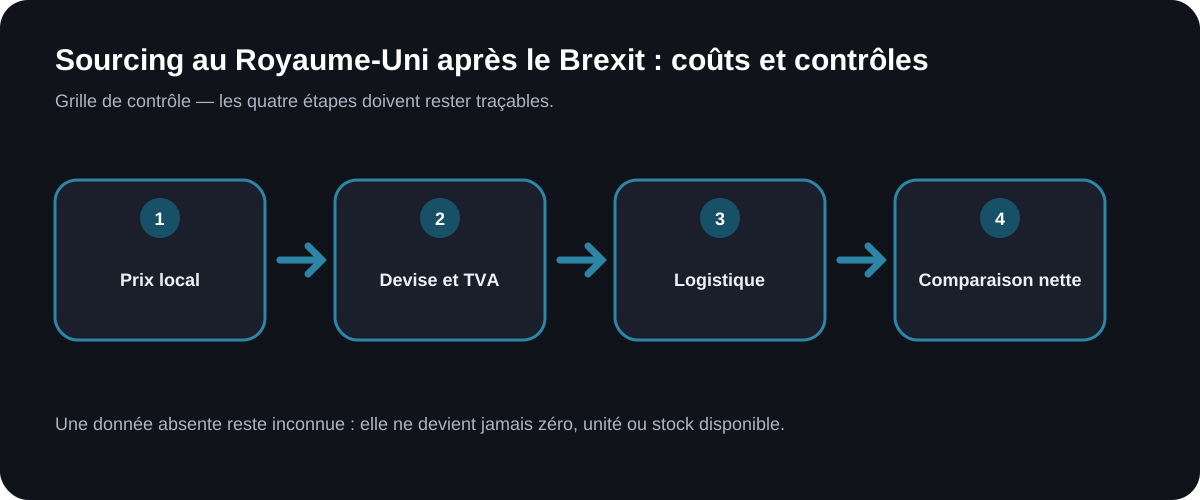
The diagram presents classification, origin, cost and control. It sets no customs duty and no tax treatment.
What the OSS does not settle
The OSS covers certain B2C transactions under its schemes. It does not replace an import customs declaration, does not prove origin, and does not determine product compliance. The VAT OSS and distance sales guide lets you check the scope after the product has properly entered the EU.
The import must also be kept separate from the Amazon sale. A profitable offer on Amazon.fr can become loss-making after brokerage, inspection or delay. Conversely, a proven zero duty rate removes neither transport nor import VAT. Keep every layer separate.
What ArbitragePro+ could automate / what the seller must verify
The checklist-import-uk (UK import checklist) feature is a proposed specification, not a confirmed feature.
| Automation proposed for ArbitragePro+ | Verification left to the seller |
|---|---|
| build the cost and document file | correctly designate the parties to the contract |
| refuse a rate with no code, origin and source | have classification and preference validated |
| separate the estimate from the declared amount | check the final customs paperwork |
| calculate a landed cost with scenarios | confirm VAT and recovery with accounting |
| flag an expired or missing document | judge product compliance and import risk |
The proposed automation would structure the file. It could not act as declarant, assign a customs code, certify an origin, or give tax advice.
Blocking checklist
- The flow correctly concerns Great Britain or Northern Ireland, as qualified.
- Exporter, importer and declarant are identified.
- The commodity code is based on the actual characteristics.
- Any tariff preference has proof of origin.
- Value, duties, VAT and fees are kept separate.
- Compliance documents cover the exact product.
- A delay and a higher cost are tested.
- Final amounts will be reconciled after import.
Official sources
Sources accessed 17 August 2026:
- European Commission — customs and tax consequences of trade with the UK
- GOV.UK — trade with the UK for an EU-based business
- GOV.UK — rules of origin for UK-EU trade
- GOV.UK — find a commodity code