Chargement de la page…
A usable Amazon landed cost adds up two layers without mixing them: the product's landed cost up to its sellable state, then the costs of the chosen selling scenario. The first includes purchase, allocated supplier freight, and prep. The second adds Amazon fees estimated from the account's current rate cards, the FBA or seller-fulfilled mode, and costs specific to the operation. Each amount must carry a status — invoiced, calculated, or hypothetical — and a consistent base. Never conclude from the purchase price alone: profitability is only readable after reconciling with dimensions, category, the intended selling price, and the fees that actually apply.
Two layers rather than one opaque total
The word "full" does not mean throwing every business expense into one cell. It means the scope is explicit. The unit landed cost measures what it took to have one sellable unit available. The Amazon scenario cost adds what depends on the sale or the channel. This separation lets you compare FBA, seller-fulfilled shipping, and another outlet without recalculating the product's past.
Amazon officially states that shipping fees vary depending on whether the seller ships the item themselves or uses Fulfillment by Amazon. For FBA, the pricing page states that certain per-unit fees depend in particular on the product's type, dimensions, and weight. The FBA page also notes that fees vary by product and by the programs used. You must therefore pull information for the specific listing being analyzed, not apply a historical average to the whole catalog.
The Amazon Revenue Calculator lets you estimate and compare fulfillment methods based on product data and shipping costs. It is a scenario source, not a final invoice. A change in measured dimensions, category, program, or rate card can change the result. Keep the date and source of each estimate.
The cost dictionary to build
A robust model uses stable families and detailed lines. The following table sets no rate: it describes where to store observed amounts.
| Layer | Component | Preferred source | Possible status |
|---|---|---|---|
| Product | supplier price net of earned discounts | supplier invoice | invoiced |
| Product | allocated inbound freight | freight invoice and allocation rule | calculated |
| Product | prep, labeling, specific packaging | provider's invoice or documented internal cost | invoiced or calculated |
| Product | applicable duties and import costs | declaration and documents for the operation | invoiced |
| Scenario | selling commission | Amazon rate card for the relevant category | estimated then invoiced |
| Scenario | FBA fulfillment or seller-fulfilled shipping | rate card/calculator or logistics invoice | estimated then invoiced |
| Scenario | storage and relevant optional services | account reports and rate cards | estimated then invoiced |
| Scenario | internal reserve for uncertain costs | documented management rule | hypothetical |
Taxes deserve their own column rather than an implicit convention. The European Commission notes that the right to deduct VAT paid on goods and services applies to taxable persons under the applicable conditions. The actual situation depends on the country, the transaction, and the seller. Have accounting validate the base used; do not automatically include every tax in the cost, and do not automatically deduct it either.
Calculation procedure before a purchase decision
1. Precisely identify the product. Check the listing, the variant, the intended category, the condition, the packed dimensions, and the weight. 2. Calculate the net unit purchase cost. Use the quantity actually received and the discounts actually earned, not a hoped-for tier. 3. Build the landed cost. Assign freight, prep, and direct costs using a traceable rule. The method for allocating shipping costs per product details this step. 4. Choose a logistics scenario. Separate FBA from seller-fulfilled shipping. Do not add two incompatible modes at the same time. 5. Import or record current Amazon fees. Use the product's category and characteristics in the official tools available to the account. 6. Define the revenue base. Compare costs and revenue on a consistent tax base, validated for your situation. 7. Label the unknowns. Any unconfirmed value remains an assumption, with a date and a justification. 8. Test several prices. A result at a single price does not show the effect of a market drop or a fee change. 9. Reconcile after the sale. Replace estimates with amounts from Amazon reports and invoices, then measure the gap.
This last step turns a theoretical spreadsheet into a learning model. If the gap often comes from weight or dimensions, improve the product data. If it comes from inbound freight, revisit the allocation key. If it comes from an Amazon service missing from the model, add a distinct line to the dictionary instead of arbitrarily increasing a general reserve.
Worked example with explicit assumptions
The following example is entirely hypothetical. The amounts reproduce no Amazon rate card, no tax rate, and no supplier offer. They serve only to make the method reproducible. Assume values expressed on the same management base validated for the fiscal year:
| Hypothetical component | Unit amount |
|---|---|
| supplier purchase | €12.00 |
| allocated inbound freight | €1.80 |
| prep and labeling | €0.70 |
| other documented direct cost | €0.50 |
| landed cost | €15.00 |
| estimated selling fee for the scenario | €3.60 |
| estimated fulfillment cost | €4.20 |
| explicit internal reserve | €0.40 |
| total scenario cost | €23.20 |
The landed cost is calculated as follows: 12 + 1.80 + 0.70 + 0.50 = €15. The total scenario cost then adds 3.60 + 4.20 + 0.40, i.e. €23.20. At a hypothetical comparable revenue of €29, the estimated profit before other out-of-scope charges would be €5.80. This difference is not a promise of gain: it only makes sense with real data, the correct tax treatment, and the stated scope.
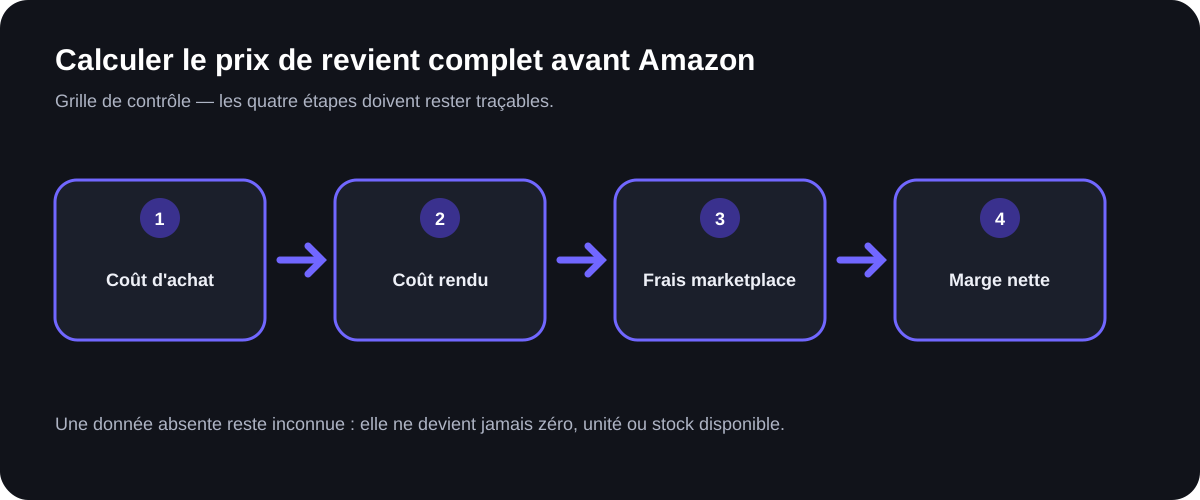
The model must display known and assumed amounts separately. If the exact commission is not confirmed, the result is provisional. If prep is done in-house, document a costing method instead of entering zero for convenience. If the reserve covers several risks, list them: it can then be adjusted based on observed gaps.
The mistakes that make margin unreadable
The first mistake is comparing a consumer-facing selling price with a cost built on another base without restating it. The second is using an average commission when Amazon publishes differentiated categories and terms. The third is forgetting that dimensions and weight can affect logistics fees. The fourth is treating a temporary benefit, a credit, or an exemption as a lasting structural cost.
Also avoid double counting. Packaging already included in the prep provider's invoice must not reappear as an internal cost. Inbound freight already built into the supplier price must not be added a second time. Conversely, "free shipping" does not prove that all costs up to the Amazon fulfillment center are covered: check the contractual delivery point and each actual leg.
Finally, do not confuse profit per unit, net margin, and ROI. These indicators use different denominators. The article ROI or net margin for Amazon arbitrage helps you choose the filter once the cost has been stabilized.
What ArbitragePro+ can automate / what the seller must verify
The landed-cost-calculator function described here is a proposed specification. It should not be understood as an already available feature.
| Proposed automation for ArbitragePro+ | Verification that remains with the seller |
|---|---|
| group costs by product and by scenario | confirm the documents, scope, and tax base |
| allocate freight using a stored key | verify the key reflects the actual billing method |
| import values and flag their date | check Amazon's category, dimensions, and weight |
| distinguish invoiced, calculated, and hypothetical | decide whether an assumption is prudent enough to buy |
| compare estimate and post-sale result | explain gaps and correct the model |
A useful automation therefore replaces neither Amazon's official tools nor reading the invoices. It assembles the inputs, reveals the gaps, and makes a scenario repeatable. The seller remains responsible for product matching, the chosen logistics mode, and the validity of the data.
Validation checklist
- The variant, condition, category, dimensions, and weight are confirmed.
- Inbound freight is allocated without double counting.
- FBA and seller-fulfilled shipping are two separate scenarios.
- Every Amazon fee comes from a current, dated rate card or tool.
- Invoiced, calculated, and hypothetical amounts are distinguished.
- The tax base and currency are consistent.
- A less favorable scenario is tested.
- The intended price is checked against the Amazon breakeven threshold.
Official sources
Sources accessed August 17, 2026:
- Amazon France — rates and selling fees
- Amazon France — Fulfillment by Amazon and Revenue Calculator
- European Commission — VAT directive and right to deduct
- EUR-Lex — Directive 98/6/EC on the indication of prices offered to consumers