Chargement de la page…
To correctly integrate shipping costs into the landed cost, allocate each cost according to what causes it: billable weight for weight-based freight, volume for a pallet constrained by space, value for a proportional insurance charge, and quantity only when the items are genuinely equivalent. Keep the total invoice amount as a control: the sum of the allocations must equal it, down to rounding. A uniform per-line split is quick, but it often makes heavy items subsidized by small ones. The right result is therefore not a universal formula; it is a documented, reproducible rule checked against the carrier's invoice.
Why a simple division distorts the landed cost
A supplier order frequently mixes very different products. Ten cables, two printers, and one armchair do not consume the same weight, the same volume, or the same handling. Yet dividing the shipping cost by the number of line items would assign the same charge to each line. Dividing by the number of units would be slightly less arbitrary, but would still put nearly the whole cost on small items when they are numerous.
The useful question is: what quantity best explains the price billed for this specific shipment? The invoice and the contractual rate card give the answer. UPS's official rate page notes, for example, that different services and additional fees may apply. This does not mean UPS is the supplier's carrier, but it illustrates why you must use the document from the actual carrier involved, at the date of shipment.
The calculation must also separate what belongs to the order from what belongs to a unit. Main freight is often shared across the shipment. Handling billed per pallet can be allocated among the items on that pallet. An identifiable special packaging can be assigned directly to the relevant item. Mixing these levels into a single key makes the result impossible to audit.
Data to collect before any calculation
Start with one control line for the order, then one line per product. The minimum fields are as follows:
| Level | Data | Use in the calculation |
|---|---|---|
| Order | billed freight, surcharges, freight discount | total to allocate |
| Product | quantity received and quantity invoiced | cost per unit actually available |
| Product | unit gross weight or billable weight | weight-based key |
| Product | packed dimensions or volume | volume-based key |
| Product | purchase value of the line | value-based key |
| Product | pallet, parcel, or special handling | direct assignment or subgroup |
| Control | currency, tax-exclusive or tax-inclusive base | consistency across all values |
The tax base must stay consistent. Do not mix a tax-exclusive purchase, a tax-inclusive freight charge, and a sale on another base. VAT treatment depends on the company's situation and the transaction; it must be validated with accounting. The EU directive on price indication concerns prices offered to consumers and notably defines the selling price in that context. It does not provide a B2B accounting allocation method. It is cited here only as a reminder that an internal cost and a consumer price are not the same thing.
Reproducible six-step procedure
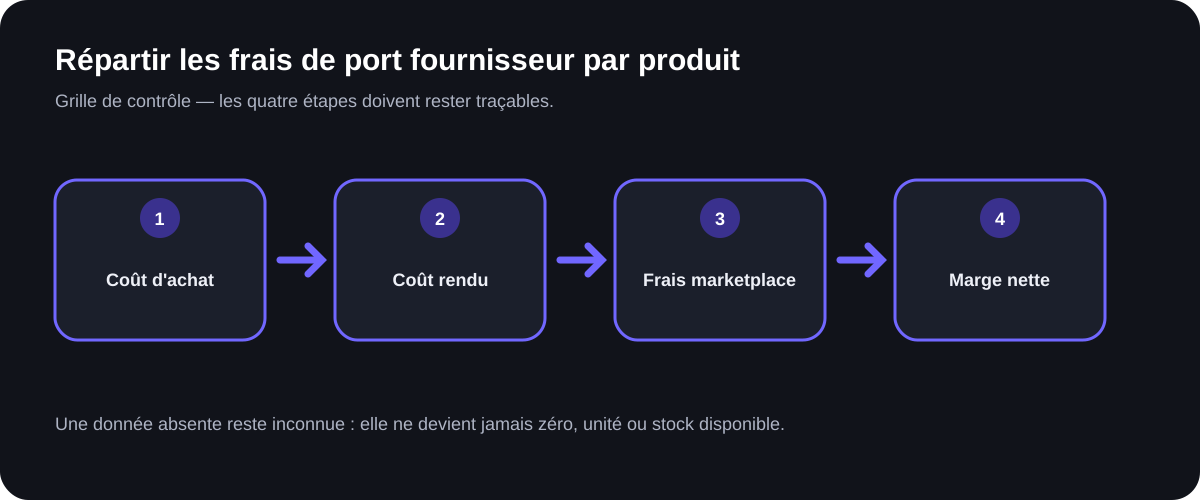
1. Reconcile the documents. Match the purchase order, the receiving record, the supplier invoice, and the freight invoice. A quote does not replace the amount finally billed. 2. Isolate direct costs. Assign to the relevant item any explicitly identifiable packaging, inspection, or surcharge. 3. Choose one key per shared cost. Use billable weight, volume, value, or a mixed key only if it matches the observed billing method. 4. Calculate each line's share. For a weight-based key, a line's share equals its total weight divided by the order's total weight, multiplied by the shared cost. 5. Bring it down to the received unit. Divide the line's allocation by the units actually available, treating shortages or damage separately. 6. Reconcile the total. Add up all allocations, make the rounding rule explicit, and check equality with the cost being allocated.
This procedure produces a landed cost, not proof of profitability. Other relevant costs must then be added and a selling price tested. The guide on full landed cost before Amazon shows how to extend the calculation. If the supplier offers tiered quantities, also check tiered discounts and unit price before allocating freight.
A fully hypothetical worked example
Suppose, purely to illustrate the method, a freight invoice of 90 euros for three received lines. The example data is invented and does not represent any market rate:
| Line | Quantity | Assumed unit weight | Total weight | Weight share | Allocated freight | Freight per unit |
|---|---|---|---|---|---|---|
| A | 20 | 0.5 kg | 10 kg | 20% | €18 | €0.90 |
| B | 10 | 2 kg | 20 kg | 40% | €36 | €3.60 |
| C | 2 | 10 kg | 20 kg | 40% | €36 | €18.00 |
| Total | 32 | — | 50 kg | 100% | €90 | — |
Line B's calculation is reproducible: 20 kg divided by 50 kg, multiplied by 90 euros, gives 36 euros; divided by ten units, that gives €3.60 per unit. A uniform per-unit split would have given €2.8125 to each product before rounding. It would therefore have overcharged A and significantly undervalued C. This contrast does not prove weight is always the best key: it only shows the effect of a key consistent with the weight-based assumption.
If the carrier bills by volumetric weight, replace actual weight with the billable measure from the freight document. If a pallet fills up before reaching its weight limit, volume may become more explanatory. For an insurance cost calculated on declared value, a value-based allocation makes more sense. A mixed key must state its weightings and remain an internal rule, never a claimed universal standard.
Handling cases that create discrepancies
Freight discounts must reduce the same cost block they relate to. Customs duties, tariffs, and taxes must not be slipped into freight without being labeled: their base and treatment may differ. Returns, damage, or missing units require an explicit decision. Depending on the management objective, their cost can be allocated to the order's sellable units, tracked in a non-quality account, or claimed back from the supplier. None of these options should be chosen silently.
For rounding, calculate with more precision than what is displayed, then assign the remainder to one line under a stable rule, for example the line with the largest allocation. Never manually correct several cells: the next import would become impossible to reproduce. Keep the rate card version, the invoice date, and the key used together with the result.
What ArbitragePro+ can automate / what the seller must verify
The landed-cost-calculator function here is a proposed specification, not a feature presented as available today.
| Proposed automation for ArbitragePro+ | Verification that remains with the seller |
|---|---|
| read order lines and suggest available keys | confirm the key matches the actual freight contract |
| allocate shared costs and directly attributable costs | check surcharges, discounts, damage, and quantities received |
| calculate the unit allocation without losing decimals | validate the tax base and currency with accounting |
| flag a gap between the invoice and the allocated sum | decide how to treat remainders and exceptional costs |
| keep the formula, source, and date of the calculation | check the carrier's document each time the rate card changes |
The proposed tool would speed up the mechanics and make assumptions visible. It could not determine on its own that a surcharge is disputable, that a pallet concerns a single item, or that a tax is recoverable. These decisions rely on the actual documents and the seller's situation.
Checklist before using the landed cost
- The final invoice, not the quote, is attached to the order.
- Received quantities are distinguished from ordered quantities.
- Each surcharge has a documented key or direct assignment.
- All values use the same currency and a consistent tax base.
- The sum of allocations equals the total to allocate after rounding.
- Assumptions and the rate card date are kept.
- The landed cost is then checked against the breakeven resale price.
Official sources
Sources accessed August 17, 2026:
- European Commission — VAT directive and links for businesses
- EUR-Lex — Directive 98/6/EC on the indication of prices offered to consumers
- FedEx France — public rates and shipping surcharges