Chargement de la page…

The breakeven resale price is the price at which comparable revenue exactly covers all the costs included in your scenario, with neither profit nor loss. To calculate it, separate the fixed costs per unit from the fees proportional to the price. In a simple model, if C represents the fixed costs per unit and r the sum of the rates actually applicable on the same price base, the threshold is C / (1 − r). This formula only holds if the fees are genuinely linear and use the chosen base. On Amazon, categories, tiers, dimensions, weight, storage, or additional services can require a piecewise calculation. So use current rate cards and test the result in the official tool.
Defining the threshold before solving an equation
A threshold only makes sense with a scope. The "purchase + commission" threshold differs from the threshold that includes supplier freight, prep, fulfillment, expected storage, and documented operating cost. Presenting the former as a complete minimum price would create false security. Start by naming the scenario and dating its inputs.
Revenue and costs must also share a consistent base. EU Directive 98/6 governs the indication of the price offered to consumers and defines the selling price in that context with applicable taxes. Your internal calculation may need a different treatment depending on the company's tax situation. So do not subtract a tax-exclusive cost from a consumer price without a validated restatement. This article sets no tax rate: that treatment depends on the actual data and the seller's accounting.
Amazon states that its fees vary by category and that FBA fulfillment fees depend in particular on the product's type, dimensions, and weight. The FBA page offers a revenue calculator to compare fulfillment modes. These sources must supply the model's current inputs. A generic formula explains the mechanism; it does not replace the rate card applicable to the listing.
Classifying costs by behavior
| Family | Data example | Treatment in the threshold |
|---|---|---|
| fixed cost per unit | landed cost, unit prep | added to C |
| fixed fee per sale | fulfillment or service billed per unit | added to C if confirmed |
| proportional fee | percentage applied to a price base | included in r per its actual rule |
| tiered fee | rate or amount that changes at a threshold | calculate per segment, not a single average |
| periodic cost | storage by duration, subscription | documented allocation or separate scenario |
| uncertain cost | return, freight variation | explicit assumption or range |
The full landed cost before Amazon helps build C without forgetting inbound freight. Do not include a component twice if it is already part of the landed cost. Conversely, an unknown cost is not zero: mark it "to be confirmed" and calculate a range.
Reproducible procedure
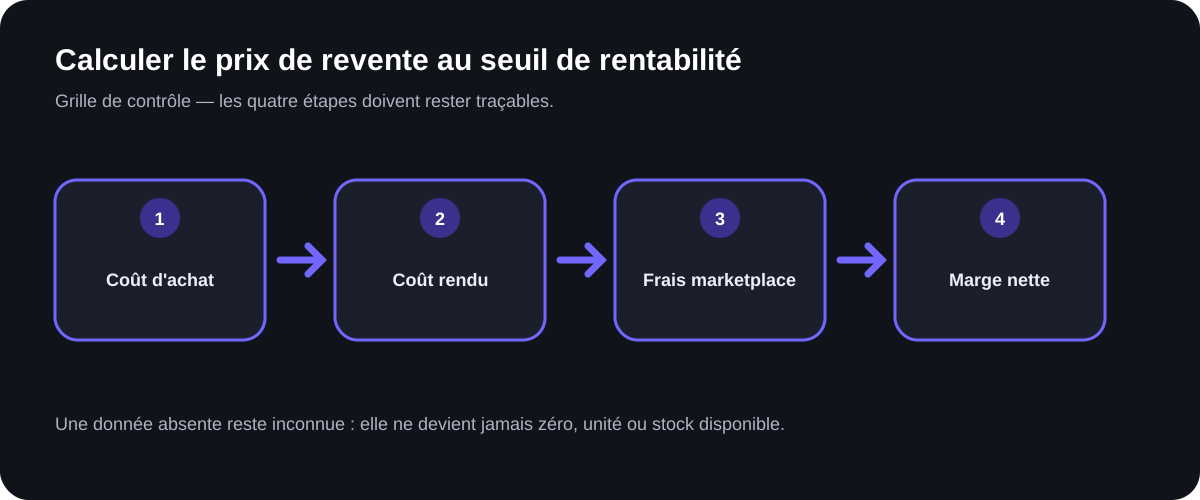
1. Choose a listing and a logistics mode. FBA and seller-fulfilled shipping are two distinct scenarios. 2. Gather the fixed unit costs. Use the invoices, documented shipping cost allocation, and applicable prep costs. 3. Record current Amazon fees. Confirm category, dimensions, weight, program, and the rate card's date. 4. Identify the base of each fee. Note whether the fee is fixed, proportional, subject to a minimum, or a tier. 5. Write the result function. Result = comparable revenue − fixed costs − price-dependent fees. 6. Solve the threshold. Use simple algebra only if the model is linear; otherwise test each segment. 7. Verify by substitution. Plug the calculated price back into every line: the result should be close to zero, allowing for rounding. 8. Test around the threshold. Calculate at least one lower price and one higher price to check the direction of change. 9. Compare to the market without concluding too quickly. A market price above the threshold is a signal, not a guarantee of a sale, volume, or that the price will hold.
Verification by substitution is essential. It catches a commission calculated on the wrong base, a forgotten fixed amount, or a poorly written circular formula. Keep the decimals during the calculation and apply a commercial rounding rule only after obtaining the mathematical threshold.
A fully hypothetical worked example
The following numbers are invented for educational purposes. The 12% rate is not presented as a current Amazon rate. Assume, on a consistent base validated for the example:
- hypothetical unit landed cost: €18;
- other hypothetical fixed costs per sale: €5;
- hypothetical proportional fee: 12% of the comparable price;
- no tier, minimum, periodic cost, or extra tax in this simplified model.
The fixed costs C equal 18 + 5 = €23. The result at a price P is therefore P − 23 − 0.12P, i.e. 0.88P − 23. At the threshold, this result is zero:
P = 23 / 0.88 = 26.1363... euros
The hypothetical mathematical threshold is therefore about €26.14 before any rounding rule specific to the seller. The substitution confirms the mechanism: 12% of 26.1363 is about 3.1364; 26.1363 − 23 − 3.1364 is close to zero, the residual gap coming from the displayed rounding.
| Hypothetical price | Proportional fee at 12% | Model result |
|---|---|---|
| €25.00 | €3.00 | −€1.00 |
| €26.14 | about €3.14 | about €0.00 |
| €28.00 | €3.36 | €1.64 |
This table only demonstrates the formula under its assumptions. If the actual rate card has a minimum, a bracketed rate, or several bases, each zone must be calculated and then checked to see which one the solution falls into. An average rate can artificially shift the threshold.
From breakeven to target price
The threshold shows where estimated profit is zero; it is not necessarily an acceptable purchase price. To target a profit per unit M in the same linear model, the formula becomes (C + M) / (1 − r). Here again, M is an internal target, not a promise of revenue. The seller must weigh this target price against demand, competition, stock, returns, and variation risk.
The ROI vs net margin Amazon comparison rounds out the analysis. Two listings can have the same threshold but employ different amounts of capital. Two others can have the same ROI but a very different distance between the observed price and the threshold. So display at minimum the observed price, the threshold, the absolute gap, the relative gap, the estimated profit, and the missing data.
An unfavorable scenario is particularly useful: a cost increase, a price drop, a longer storage duration, or a different logistics measurement. Variations must be plausible and labeled as assumptions. It is better to display three conditional results than to reduce significant uncertainty to a single, overly precise price.
What ArbitragePro+ can automate / what the seller must verify
The breakeven-calculator function is a proposed specification, not a feature declared to be in production.
| Proposed automation for ArbitragePro+ | Verification that remains with the seller |
|---|---|
| classify fixed, proportional, and tiered costs | confirm the rate card and the base of each fee |
| solve the threshold and run the control substitution | validate category, dimensions, weight, and logistics mode |
| display assumptions and their date | decide whether they are realistic and prudent enough |
| compare threshold, observed price, and scenarios | check the quality and freshness of the observed price |
| flag missing data or a non-linear formula | consult official tools and arbitrate edge cases |
The proposed automation would make the calculation auditable: each output would stay linked to its inputs and its formula. It could not guarantee the product will sell at the tested price, nor that fees will stay constant. The purchase decision remains the seller's, based on several signals.
Checklist before setting a minimum price
- The cost scope is written down and complete for the scenario.
- The tax base and currency are consistent.
- Fixed costs contain no double counting.
- Proportional fees use their real base and current rate card.
- Tiers and minimums are treated separately.
- The threshold is checked by substitution.
- A lower price and a higher price have both been tested.
- Unknown data remain visible as assumptions.
- The observed price is not treated as a guaranteed future sale.
Official sources
Sources accessed August 17, 2026:
- Amazon France — rates and selling fee families
- Amazon France — Fulfillment by Amazon and Revenue Calculator
- EUR-Lex — Directive 98/6/EC on the indication of prices offered to consumers
- European Commission — VAT directive and information for businesses