Chargement de la page…
To calculate the true unit price of a wholesale tier, apply the rate to the actually orderable quantity, add the fees tied to that order, then divide by the number of resellable units. First check whether the price applies to a unit, a pack, or a carton, whether it is tax-excl. or tax-incl., and whether the minimum or increment changes the quantity. A percentage discount is not enough: a tier can lower the purchase price while increasing total cost, storage, or exposure to unsold stock. So compare several realistic quantities on a landed unit cost and keep all assumptions on record.
Break down the offer before calculating
A price table might show "1–9," "10–49," and "50+" without clearly stating whether these numbers refer to pieces, packs, or cartons. Ask for the official definition of the sales unit. Record separately:
- the source price and its currency;
- the tax-excl., tax-incl., or unknown basis;
- the number of resellable units per pack;
- the overall minimum order and the product-specific one;
- the order increment;
- the inclusive bounds of each tier;
- fixed and variable applicable fees;
- the duration or conditions of a promotion.
The European directive 98/6/EC provides, for consumer information within its scope, definitions of the selling price and the unit price including VAT and other charges. It does not establish the nature of a B2B rate. For a wholesale catalog, proof of tax-excl./incl. status must come from the supplier's documentation, contract, or invoice.
A simple formula, demanding inputs
For a given quantity, use a transparent formula:
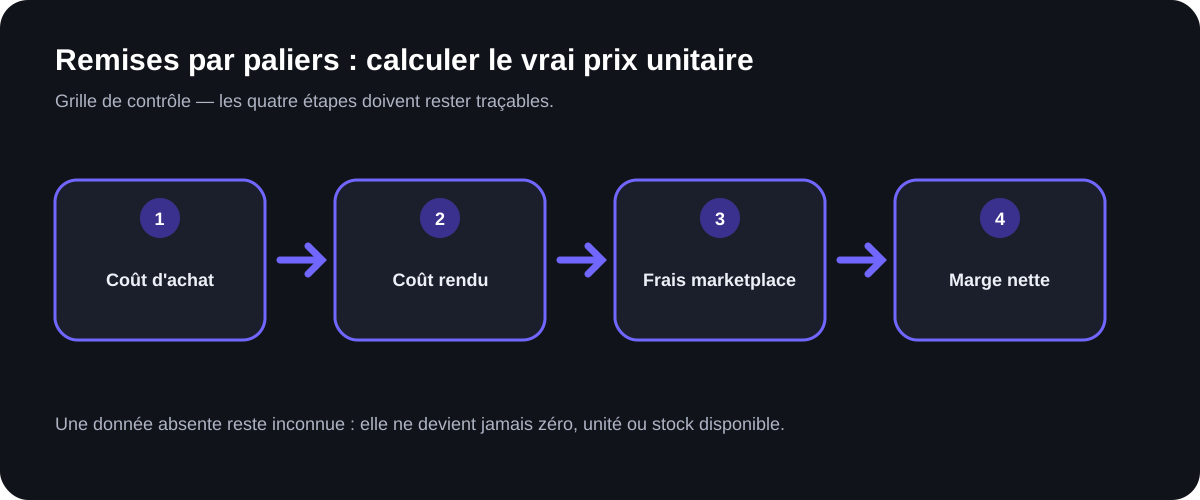
landed unit cost = (goods price + fees allocated to the line) / resellable units received
If the supplier gives a per-carton price, the goods price equals number of cartons × carton price. If the price is per unit, it equals number of units × the tier's unit price. Only add a discount if it isn't already included in the rate. Double-counting a reduction is a common mistake.
| Data point | Control question | Cautious handling |
|---|---|---|
| Tier bound | Does 10 mean at least 10 units or 10 cartons? | use the documented unit |
| Price | Does it apply to the piece or the lot? | keep both levels |
| MOQ | Is it global or per reference? | do not allocate it arbitrarily |
| Increment | Can you buy 12 after a MOQ of 10? | generate only compliant quantities |
| Fees | Are they fixed, weight-based, or value-based? | apply the real rate table |
| Breakage/loss | Is the resellable count lower than received? | use only a justified assumption |
A reproducible example with hypothetical data
Suppose a fictional supplier sells a carton of 6 units. The hypothetical carton price would be EUR 54 excl. VAT for 1 to 4 cartons, then EUR 48 excl. VAT from 5 cartons onward. Also suppose EUR 18 shipping for the order studied, with no other fees. These values describe no real supplier.
For 4 cartons, the goods would cost 4 × 54 = EUR 216 and provide 24 units. The landed cost would be (216 + 18) / 24 = EUR 9.75 excl. VAT per unit. For 5 cartons, the goods would cost 5 × 48 = EUR 240 and provide 30 units. The landed cost would be (240 + 18) / 30 = EUR 8.60 excl. VAT per unit.
Here, the second tier lowers the unit cost under these assumptions, but ties up EUR 24 more in goods and adds 6 units to sell through. The decision must factor in sales capacity, lead time, storage, and price-change risk. The example predicts no profitability.
Redo the calculation for every quantity compatible with the order increment, not just at the bounds. Shipping that increases by weight bracket can create a discontinuity: a higher quantity's unit cost is not always lower. The method for allocating shipping costs per product should be chosen based on the carrier's rate table or invoice, never presented as a universal legal rule.
Comparing tiers on more than a percentage
The relative discount is calculated from a verified base: (base price - tier price) / base price. But it doesn't answer the essential question: how much does one landed unit cost for the possible order? Display side by side:
1. quantity ordered; 2. resellable units; 3. total goods price; 4. allocated fees; 5. landed unit cost; 6. cash committed; 7. difference from the previous tier; 8. date and origin of the rate.
This presentation also facilitates the comparison of two suppliers on the same EAN. Supplier A might win at small volume and supplier B at a full carton. There is therefore no single ranking without a target quantity.
Handling promotions, retroactive rebates, and free-shipping thresholds
A dated promotion should not permanently replace the standard rate. Store the period, the conditions, and the proof. A retroactive rebate calculated at the end of a period should not immediately reduce the cost of every line if obtaining it remains uncertain. Create one scenario with the confirmed rebate and another without it.
Free shipping is also an order threshold, not a product discount. If an additional order lets you cross the threshold, compare the total cost of both baskets. Adding unnecessary items to save on shipping can increase cash outlay and dormant stock. Free shipping should remain an attribute of the overall order, then be allocated only according to a documented management convention.
Finally, check rounding. Calculate with sufficient precision, keep the line amounts, and only round the unit price for display. A succession of intermediate roundings can distort large quantities.
Checklist before choosing a tier
- The tier's unit is documented.
- The price is unambiguously tied to a pack or a piece.
- The currency and tax-excl./incl. basis are confirmed.
- The MOQ and order increment are applied.
- The discount is not counted twice.
- Fees come from the relevant rate table or quote.
- Resellable units are distinct from cartons purchased.
- Promotions and retroactive rebates have a separate scenario.
- Total cash outlay appears next to the unit cost.
- Assumptions and the timestamp are kept.
What ArbitragePro+ can automate / what the seller must verify
The proposed calculateur-prix-unitaire specification could generate orderable quantities, apply each tier, and display the landed unit cost with its assumptions. It should refuse calculations if the unit, currency, or price nature is unknown.
The seller must confirm the pricing terms, carton contents, applicable fees, promotions, VAT, and the volume they can reasonably sell through.
Test your cost assumptions
Open ArbitragePro+ analysis to review the available data and cost scenarios.
Official sources
- EUR-Lex, consolidated directive 98/6/EC on price indication, https://eur-lex.europa.eu/legal-content/FR/TXT/?uri=CELEX%3A01998L0006-20220528 — accessed 2026-08-17.
- European Commission, «VAT Directive», https://taxation-customs.ec.europa.eu/taxation/vat/vat-directive_en — accessed 2026-08-17.