Chargement de la page…
Before any firm order, check in your own Seller Central that you can list the exact ASIN, in the intended condition and on the target store. Then check approval requests, compliance documents, FBA restrictions, dimensions, weight, the fee category and the logistics mode. Recalculate the scenario with current data, then archive dated evidence. A listing visible on Amazon or a favorable price history does not prove your account can sell the product. If an approval, a document, a cost or a variant match remains uncertain, suspend the order or scale it down to a reversible test. This checklist is an operational control, not a guarantee of future acceptance by Amazon.
Public visibility is not enough
The public product page answers a customer question: what is currently shown in the store? Seller Central answers seller questions: can this account create or join the offer, what evidence is requested, what logistics data will be used, and which program is available? Confusing these two levels produces purchases that cannot be listed for sale.
Amazon publicly states that certain categories, brands or SKUs may be subject to restriction and that approval may be requested in Seller Central. Requirements can also vary by product and country. Amazon's official compliance hub groups verification, tax, product, environmental and international trade requirements. These checks are therefore not a single formality valid for the entire catalog.
An approval observed today is not a permanent right. Archive the date, the ASIN, the store and the verification status. Never save a screenshot containing a token, a personal address, an account identifier or sensitive supplier information.
The minimum file before buying
| Block | Question to resolve | Evidence expected |
|---|---|---|
| identity | does the ASIN match the model, size, color and batch? | matching spec sheet, GTIN, photos and label |
| right to sell | can the account list this item in this condition? | dated check in Seller Central |
| compliance | which documents and markings apply? | verified manufacturer or supplier documents |
| provenance | does the invoice meet possible audit requirements? | supplier terms and sample invoice |
| logistics | does FBA accept the product and its characteristics? | confirmed dimensions, weight, packaging and restrictions |
| economics | are fees and landed cost current? | dated calculation with a source for each cost |
| tax | do storage and sale create obligations? | professional advice and documented country settings |
Evidence must match the SKU, not just the brand. A certificate meant for another model or an invoice with no clear identification does not resolve the check. When a supplier promises a document after payment, treat it as missing until received and validated.
Control procedure, in order
1. Lock the product. Record ASIN, GTIN, model, variant, condition, quantity per lot and the packaging language. 2. Test adding the listing. In the account concerned and the correct store, check any restrictions or approval requests that apply. 3. Read the compliance requirements. Identify relevant product documents, packaging information, responsible person or environmental obligations. 4. Confirm provenance. Check that the supplier can issue a complete invoice and link the products to the order. 5. Validate logistics. Choose FBA or seller-fulfilled, then check eligibility, prep, dimensions and weight. 6. Update the fees. Use Amazon's official tools with the category and mode selected. 7. Recalculate the scenario. Fold purchase, transport, prep and channel fees into the full Amazon landed cost. 8. Test price risk. Don't rely on the current value alone; weigh it against price history and its limits. 9. Archive the decision. Keep the checks, assumptions, owner and chosen expiry date.
This order avoids spending time on a theoretical margin when the product is blocked. It also avoids the opposite mistake: getting approval, then ordering without calculating the real logistics cost.
A public screenshot, with no false claims
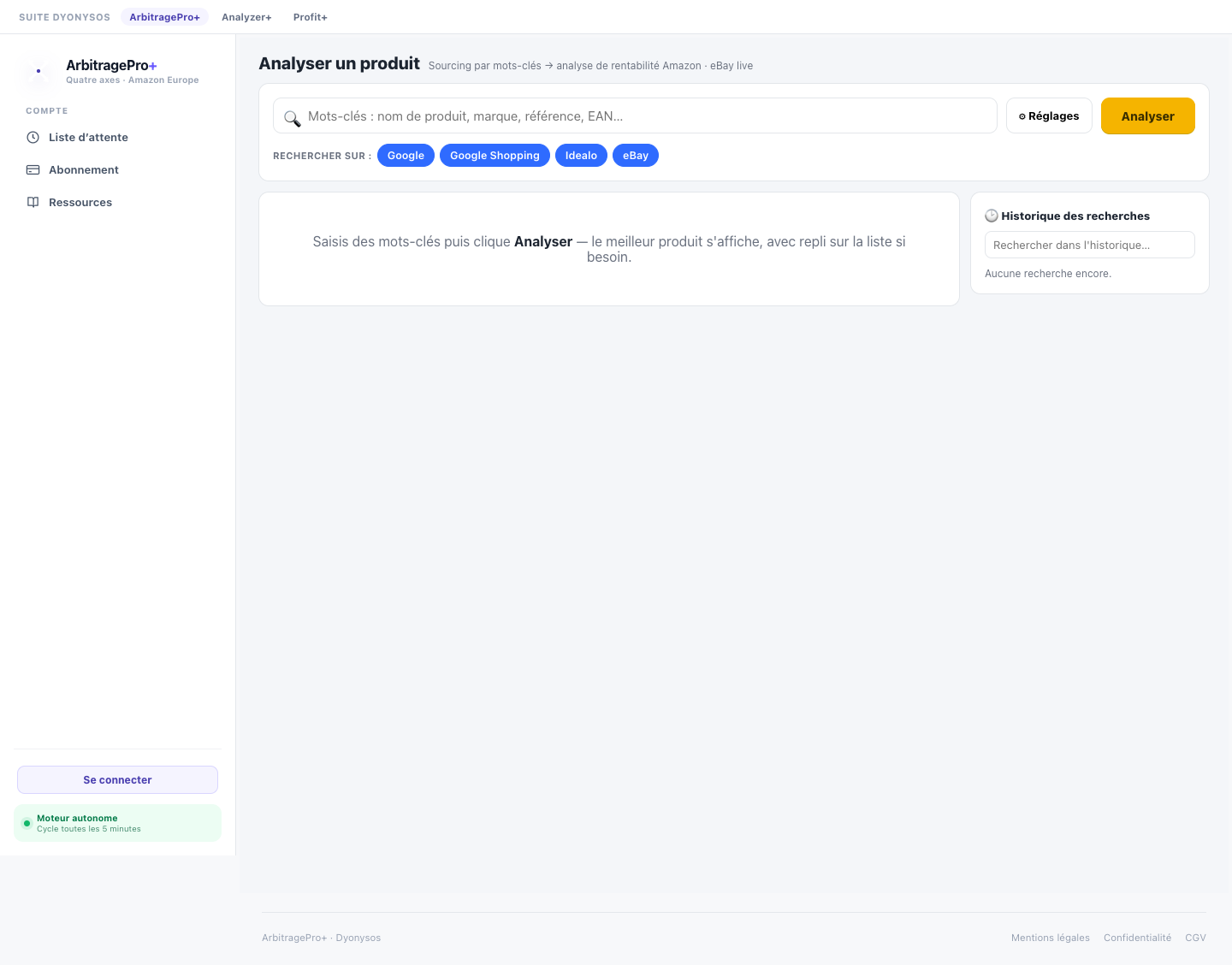
This screenshot shows only the redacted public state of the /analyser route. It proves neither the existence of an authenticated checklist, nor a Seller Central connection, nor authorization to sell an ASIN. Account checks must be carried out by the seller in their own Amazon session, without exposing their data.
Deciding: order, test or block
The final decision can use three simple states: validated, to confirm, blocking. A "to confirm" line has an owner and a deadline. A blocking line prevents the order until resolved. The "not applicable" status requires a justification; it must not be used to sidestep a hard question.
A small test batch reduces commercial exposure, but does not resolve non-compliance. It's useful for validating packaging, receiving, quality or logistics measurements once the right to sell and compliance are already established. It must never be presented as a way to try out a prohibited SKU.
For a cross-border sale, add the storage country, the customer's country and the shipping route. The VAT OSS checklist covers declaring distance B2C sales, without replacing national obligations linked to storage.
What ArbitragePro+ could automate / what the seller must verify
The checklist-avant-commande (pre-order checklist) feature is a proposed specification. The public screenshot does not demonstrate that it exists in the application.
| Automation proposed for ArbitragePro+ | Verification left to the seller |
|---|---|
| generate a checklist based on store, condition and logistics | carry out the real check in their Seller Central account |
| attach documents and dates to the product | validate the legal and technical scope of the documents |
| flag missing data or evidence | obtain the supplier's paperwork before payment |
| recalculate the scenario from dated costs | confirm category, weight, dimensions and Amazon fees |
| block a decision when the status is incomplete | own the decision to order or walk away |
The proposed automation would structure the evidence and prevent an implicit "yes." It would have no power to grant Amazon authorization, certify a product, or provide tax or legal advice.
Final checklist
- The ASIN and every attribute physically match the product.
- The account can sell the item, in this condition, on this store.
- Approval requests are resolved, not just submitted.
- Compliance documents cover the exact SKU.
- The invoice and supplier traceability are acceptable.
- The logistics mode, dimensions and weight are confirmed.
- Amazon fees and landed cost are dated.
- A downside scenario remains viable.
- VAT and storage obligations have been reviewed.
- The decision and its evidence are archived with no sensitive data.
Official sources
Sources accessed 17 August 2026:
- Amazon — selling guide and restricted categories
- Amazon — seller partner compliance hub
- Amazon — product compliance
- Amazon — fees and revenue calculator