Chargement de la page…
To compare Amazon France and Germany, start from the same product and rebuild two complete scenarios on a consistent tax basis. Do not directly compare the displayed consumer prices. Remove or handle VAT according to the seller's validated situation, then apply Amazon fees, the logistics mode, transport, storage and the compliance obligations specific to each scenario. Check the ASIN, the variant, the condition, the category and the observation date on each store. France and Germany both use the euro, but no currency conversion being needed doesn't make the revenues comparable. A price difference is only an opportunity after full cost, right to sell, taxation and stock risk.
Comparing two scenarios, not two labels
The price shown on Amazon.fr and the one shown on Amazon.de follow each store's rules and the context of the observed offer. The seller, the shipping mode, the condition, the lot quantity and availability can all differ. The first step, then, is to prove that the two observations concern the same commercial product: model, variant, GTIN, accessories, language and packaging.
The second step is accounting. The European Commission notes that VAT rates vary between member states and that the most reliable source for the current rate of a given product remains the national tax authority; the TEDB database provides an overview. Do not apply a standard rate from memory to a product that may fall under a different treatment. Keep the country of taxation, the sourced rate and the date alongside the calculation.
The third step is logistics. Amazon offers several European solutions, including Pan-European FBA and the EFN network. The storage location affects both obligations and fees. Comparing a domestic shipment in France to a cross-border shipment to Germany without distinguishing these flows would create an artificial gap.
The France-Germany cost grid
| Block | France scenario | Germany scenario | Evidence required |
|---|---|---|---|
| product | ASIN, variant, condition | ASIN, variant, condition | documented match |
| revenue | price and FR tax basis | price and DE tax basis | timestamped observation |
| Amazon | applicable category and fees | applicable category and fees | current fee schedule/calculator |
| logistics | storage and delivery | storage and delivery | program actually selected |
| compliance | French requirements | German requirements | documents by country and product |
| environment | applicable obligations | applicable obligations | verified EPR status |
| risk | low price and delay | low price and delay | downside scenario |
Amazon devotes a section to extended producer responsibility requirements in Germany, notably for packaging and electrical/electronic equipment. This does not mean these are the only obligations for every product. It requires the seller to identify their category and check the current requirements for the country before opening or feeding a listing.
Reproducible procedure
1. Lock down identity. Confirm GTIN, ASIN, variant, quantity, condition and package contents on both stores. 2. Timestamp the listings. Record price, seller, shipping and availability at as close to the same moment as possible. 3. Normalize revenue. Convert each price into comparable revenue based on the validated tax treatment. 4. Calculate Amazon fees. Use the tools and fee schedules for the store, category and program concerned. 5. Trace the physical flow. Note the country of origin, authorized storage, the customer's country and returns handling. 6. Add compliance. Check right to sell, product safety, packaging and EPR in each country. 7. Build three scenarios. Test an observed price, a documented central price, and a downside assumption. 8. Decide on the net gap. Keep the costs, evidence, unknowns and expiry date of the analysis.
The Pan-European FBA or EFN comparison helps describe the logistics flow. It does not replace tax advice: storing goods in a country can have consequences distinct from distance sales declarable via the OSS.
Before interpreting the gap between the two stores, also qualify the number and type of offers using the Amazon seller and competition method. A higher price in one country is not on its own proof of weaker competition or higher demand.
An example table with no invented rate
Suppose two fictional listed prices, 36 euros in France and 39 euros in Germany. These amounts belong to no ASIN. Do not apply an arbitrary VAT rate. Instead enter revenue_FR and revenue_DE using the method validated by accounting. Then add Amazon_fees, logistics, allocated_compliance and product_cost for each scenario.
The working formula becomes: result_country = comparable_revenue − product_cost − Amazon_fees_country − logistics_country − other_documented_costs. If any cell is unconfirmed, show a range or block the ranking. The German result must not receive the French fees by default just because the category shares a similar name.
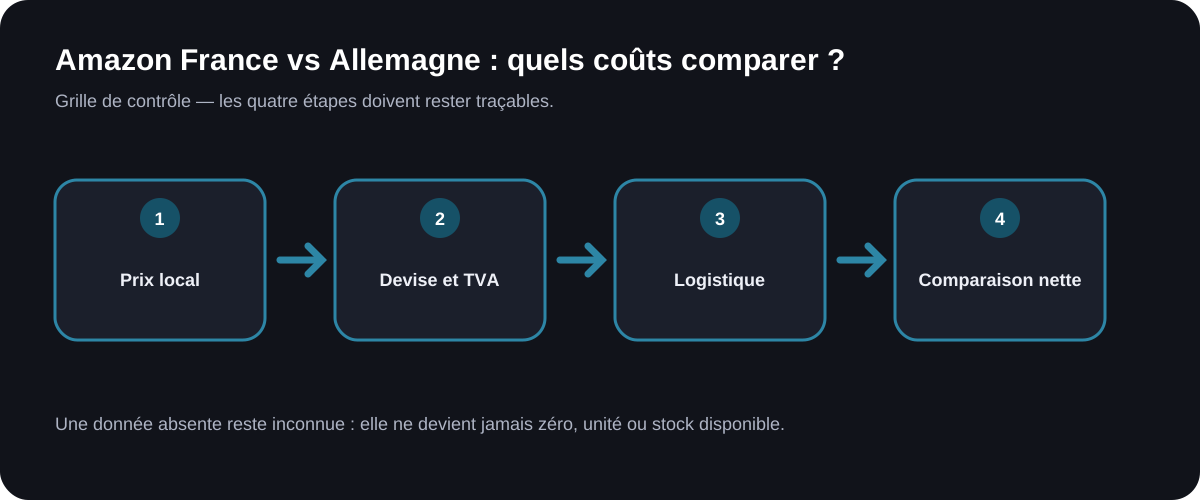
The graphic describes four steps — matching, normalization, cost, control — without using any market data. It demonstrates no actual profitability.
Country-specific mistakes to avoid
A close translation does not establish a product match. The same ASIN visible on multiple stores does not guarantee an active offer for your account. An EPR obligation settled in France does not prove German compliance. A higher German price does not necessarily offset a cross-border fee or a higher return cost.
Also avoid reducing the comparison to VAT alone. The France-Italy comparison shows how to normalize price and fees, while the France-Spain method emphasizes observation quality. These three files share a structure, but each country requires its own current sources.
What ArbitragePro+ could automate / what the seller must verify
The comparateur-a2a (Amazon-to-Amazon comparator) feature is a proposed specification, not a confirmed feature of the application.
| Automation proposed for ArbitragePro+ | Verification left to the seller |
|---|---|
| align two observations by product and store | confirm the physical and commercial match |
| keep price, fees, source and timestamp | check current Amazon tools and authorities |
| calculate two scenarios on a chosen basis | have the tax and accounting treatment validated |
| flag a missing country data point | obtain compliance and EPR evidence |
| show the net gap and the assumptions | decide whether the risk justifies an order |
The proposed automation would make the calculation explainable. It could not assign a tax rate, certify compliance, or guarantee a future price without valid official data.
Final checklist
- The product, variant, condition and lot match.
- Both observations are dated and qualified.
- The tax basis is consistent and validated.
- Amazon fees come from each store's own settings.
- Storage and transport reflect the real flow.
- EPR and product requirements are checked per country.
- A downside scenario remains visible.
- Any unknown blocks or bounds the ranking.
Official sources
Sources accessed 17 August 2026:
- Amazon — selling on European stores
- Amazon — extended producer responsibility requirements
- European Commission — VAT for businesses and rate sources
- Amazon — fees and revenue calculator