Chargement de la page…
A reliable Amazon France-Italy comparison starts by turning each displayed price into comparable revenue, then rebuilding the fees for the local scenario. Identify the same product, the same variant, the same condition and the same packaging. Document the country of taxation and the rate actually applicable to the product instead of reusing a rate from memory. Then record the Amazon category, commission, logistics mode, storage, transport and compliance costs on each store. The price difference including all taxes is not a margin. As long as a tax, logistics or product data point remains uncertain, the gap must be shown as a range or placed in review, never ranked as a certain opportunity.
Why normalization comes before margin calculation
A consumer price embeds a tax and commercial context. The European Commission states that VAT rates vary between member states and can also vary depending on the nature of the product. It recommends national authorities as the most reliable source for current rates, with TEDB as an overview. A serious comparison therefore keeps the country, the tax category, the sourced rate and the date.
The general formula price excl. tax = price incl. tax / (1 + rate) is only usable if the price and the rate genuinely have that meaning for the transaction. It does not decide which country VAT is due in and does not replace the accounting treatment. The Commission specifies that the place of taxation for intra-EU distance sales is, under the general rule, the country where transport to the consumer ends, subject to the applicable conditions and exceptions.
The OSS can simplify the declaration of certain cross-border B2C sales, but it does not turn every flow into a single domestic transaction. The storage location, stock transfers and domestic sales still need to be analyzed separately.
The four layers to align
| Layer | France | Italy | Check |
|---|---|---|---|
| product | identity and packaging | identity and packaging | GTIN, ASIN, model, variant |
| price | observed price and seller | observed price and seller | time, condition, delivery included or not |
| taxation | scenario basis and rule | scenario basis and rule | official source and accounting validation |
| channel | category, fees, logistics | category, fees, logistics | current Amazon tools |
The translation deserves its own check. An Italian title may omit a quantity or use a different unit. Compare the images, the manufacturer reference, the GTIN, the dimensions and the lot contents. A word match is only a clue.
Reproducible France-Italy procedure
1. Identify the master product. Record GTIN, brand, model, variant, lot size and condition. 2. Link the local listings. Match the French ASIN and the Italian ASIN with evidence, without assuming they are identical. 3. Capture the full price. Note the seller, fulfilment mode, delivery, availability and timestamp. 4. Determine the tax basis. Have the country of taxation validated and look up the product's rate in a current official source. 5. Normalize revenue. Produce a comparable value while keeping the formula and rounding consistent. 6. Apply Amazon fees. Use the actual category and program for each store. 7. Trace logistics. Distinguish local storage, EFN, Pan-European and seller-fulfilled shipping. 8. Add compliance and returns. Include documented costs, without inventing an average flat fee. 9. Test a downside scenario. Lower revenue or raise a variable based on an explicitly justified assumption.
The VAT OSS and distance sales file helps separate what the OSS can declare from what it doesn't replace. For the international cost structure, the France-Germany comparison offers a complementary grid.
An algebraic example instead of a fake rate
Suppose fictional prices P_FR and P_IT, with rates t_FR and t_IT obtained from the official sources applicable to the product. Normalized revenues are P_FR / (1 + t_FR) and P_IT / (1 + t_IT), provided this formula genuinely matches the situation validated. The results then become:
R_FR = revenue_FR − landed_cost − fees_FR − logistics_FR
R_IT = revenue_IT − landed_cost − fees_IT − logistics_IT
Using symbols avoids publishing a national rate as though it were valid for every SKU and every date. An internal numeric test may use assumptions, but they must be labeled and replaced with current values before a decision.
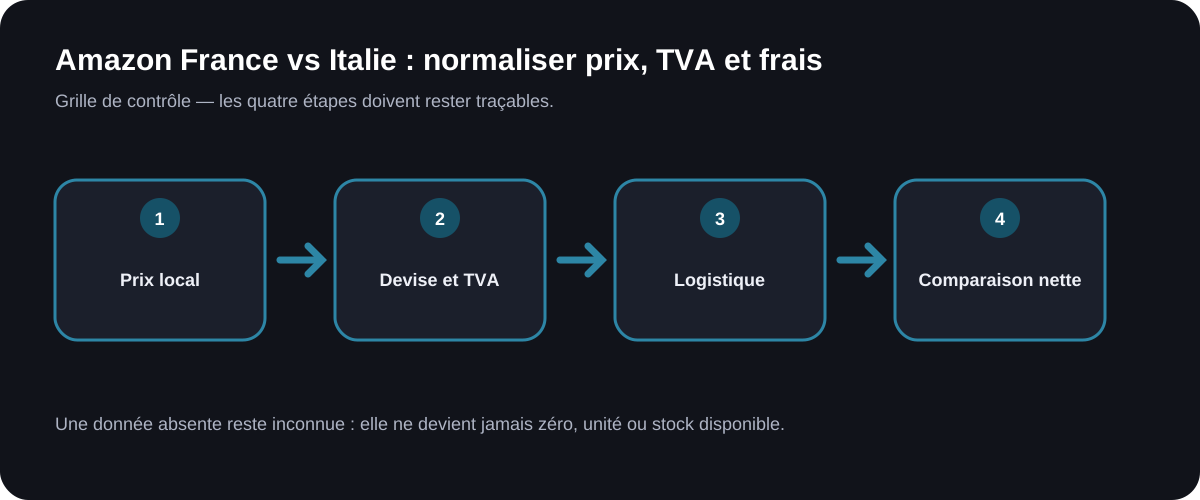
The graphic summarizes matching, taxation, fees and control. It contains no rate, price or invented result.
Amazon category and tax category are not the same thing
The Amazon category determines catalog rules and can affect selling fees. The tax category determines the VAT treatment. They can carry similar-sounding names without being equivalent. Keep both fields. A change in Amazon category does not on its own justify a change in tax rate; conversely, a particular tax rate does not set the Amazon commission.
Amazon states that selling costs depend in particular on the plan, the category, the shipping strategy and other variables. Use its revenue calculator or the reports available in the account, then archive the date. An old export should not indefinitely feed the comparator.
The France-Spain method emphasizes freshness and observation quality. It's useful here too: an Italian price with no deliverable offer, or a French data point taken on a different day, does not form a fair pair.
What ArbitragePro+ could automate / what the seller must verify
The comparateur-a2a (Amazon-to-Amazon comparator) feature is a proposed specification and must not be presented as already available.
| Automation proposed for ArbitragePro+ | Verification left to the seller |
|---|---|
| gather two listings and show their attributes | confirm it's genuinely the same sellable product |
| record price, country, entered rate and source | validate the place of taxation and the applicable rate |
| recalculate revenue and costs on a common basis | check each store's Amazon fees |
| flag observations that are too old | decide the acceptable freshness window |
| produce several scenarios without hiding unknowns | assess compliance, demand and stock risk |
The proposed automation would ensure traceability of inputs. It would not provide tax advice, guess a product match, or guarantee any sale.
Checklist before ranking
- GTIN, model, variant and lot are consistent.
- Sellers, conditions, deliveries and dates are recorded.
- The country of taxation is determined for each flow.
- The rate comes from a current official source.
- The tax category is kept separate from the Amazon category.
- Fees and the logistics program are country-specific.
- Storage-related obligations are reviewed.
- Unknowns produce a review or a range.
Official sources
Sources accessed 17 August 2026:
- European Commission — VAT place of taxation
- European Commission — VAT for businesses and national sources
- Amazon — selling across Europe
- Amazon — fees and revenue calculator