Chargement de la page…
To compare Amazon France and Spain, require a synchronized, qualified pair of observations: same product, variant, condition, quantity, identifiable seller, delivery and availability. Then normalize taxation and fees using current sources. A Spanish price seen yesterday and a French price recorded today do not form a clean comparison if the market has moved. Add a freshness status, keep the URL or identifier, then calculate each scenario with its own logistics mode and storage country. If the product match, delivery to the target customer, or a tax obligation remains unknown, the line must go to review. The reliability of the input matters more than the decimal precision of the result.
Pair quality before the price gap
A price difference is only usable if both of its terms are comparable. The same translated title may refer to a different pack. An ASIN can vary by marketplace; SP-API documentation handles catalogs in the context of a marketplaceId. You therefore need to map identifiers and attributes, not copy an identifier without checking it.
Availability must be qualified. "In stock" may refer to a different seller or shipping mode. The price charged to the customer may or may not include delivery depending on the offer. Record the product price, the displayed shipping cost, the condition, the seller, the fulfilment mode and the time. An offer that cannot be delivered to the test address is not a real accessible competing price in that scenario.
Finally, the tax calculation is not just about stripping out a standard national rate. The Spanish tax agency (Agencia Tributaria) publishes information on regimes, filings, the taxable base, rates and foreign trade operations. The European Commission reminds us that the current rate for a product must be checked with the national authorities.
Evidence sheet for an observation
| Field | Why it matters | Reason for review |
|---|---|---|
| marketplace and timestamp | situates the data | missing store or date |
| ASIN, GTIN, model | links the product | unproven variant |
| condition and packaging | avoids false gaps | new compared to used |
| seller and shipping | qualifies the offer | non-deliverable offer |
| product price and shipping | rebuilds the total | unknown delivery cost |
| availability | measures executability | stockout or ambiguous message |
| tax source | normalizes revenue | rate from memory, undated |
| fee source | calculates channel cost | generic or outdated schedule |
This sheet is proof of collection, not proof of a future sale. It lets another analyst reproduce the comparison and understand why a line was kept or rejected.
Four-gate procedure
Gate 1 — Match
Confirm brand, SKU, GTIN, variant, pack quantity, condition and accessories. If the ASINs differ, document the link. The guide on mapping the same product across multiple Amazon marketplaces details this evidence.
Gate 2 — Observation
Collect both offers within a defined time window. Note any difference in seller, shipping cost or availability. Reject truncated or non-deliverable data rather than assigning it a zero.
Gate 3 — Normalization
Determine the country of taxation, the rate applicable to the product, and a comparable basis with accounting. Add the Amazon and logistics fees specific to the scenario. The France-Italy file explains this separation between tax category and Amazon category.
Gate 4 — Decision
Calculate the net gap, a downside scenario, and the sensitivity to freshness. Archive the sources, then set a date after which the analysis must be refreshed.
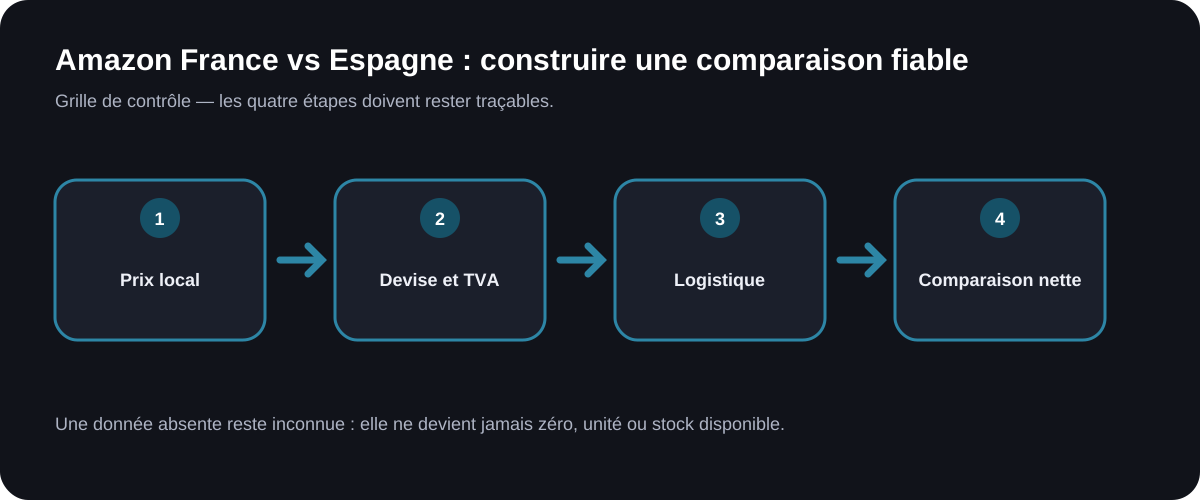
The graphic represents these four gates with no numeric data and no authenticated feature.
A hypothetical example of a freshness decision
Suppose a fictional French observation timestamped at 10:00 and a fictional Spanish observation timestamped at 10:07, both for a product whose identity is confirmed. The seven-minute gap is a teaching assumption, not a universally acceptable norm. The seller sets their own window based on volatility and collection frequency.
If the Spanish line then shows "unavailable" during the manual check, the earlier price must not stay active. It moves to history or to review. If the shipping cost is missing, the result becomes a range until confirmed. If the Spanish ASIN turns out to be a two-unit pack, the pair is rejected despite the similarity of the titles.
This logic prevents false positives better than a very strict margin threshold applied to bad inputs. It complements the France-Germany comparison, where per-country compliance obligations get particular attention.
Fees, storage and returns
Amazon states that its costs vary by plan, category, shipping and other factors. Pull the fees from current tools and attach them to the country. Storage in a member state can create obligations distinct from distance B2C sales. Outbound transport and returns handling must reflect the program actually used: seller-fulfilled, EFN and Pan-European are not synonyms.
Do not create an average "Spain cost" covering every category and every size. Keep the components separate. This granularity lets you replace a rate without redoing the product match, and lets you trace the origin of a post-sale discrepancy.
What ArbitragePro+ could automate / what the seller must verify
The comparateur-a2a (Amazon-to-Amazon comparator) feature is a proposed specification, not a confirmed capability of the application.
| Automation proposed for ArbitragePro+ | Verification left to the seller |
|---|---|
| collect timestamped observations and their attributes | confirm actual deliverability and the real seller |
| check that evidence fields are present | examine variant and pack ambiguities |
| normalize two scenarios with dated sources | validate the tax treatment and current fees |
| expire a comparison that has gone stale | choose the window suited to the product |
| send doubtful pairs to review | decide whether the evidence is sufficient to buy |
The proposed automation would reduce oversights and preserve the chain of evidence. It could not guarantee the accuracy of an external offer, a future sale, or the seller's tax compliance.
Final checklist
- Product identities are proven, not just similar.
- Both observations are close in time and timestamped.
- The seller, condition, shipping cost and deliverability are qualified.
- The country of taxation and the product's rate are sourced.
- Fees reflect the category and logistics of the scenario.
- Storage and returns are included.
- Old data expires automatically or goes to review.
- The downside scenario contains no implicit zero.
Official sources
Sources accessed 17 August 2026:
- Amazon — selling across Europe
- Amazon — fees and cost variables
- European Commission — VAT for businesses
- Spanish Tax Agency — official VAT portal