Chargement de la page…
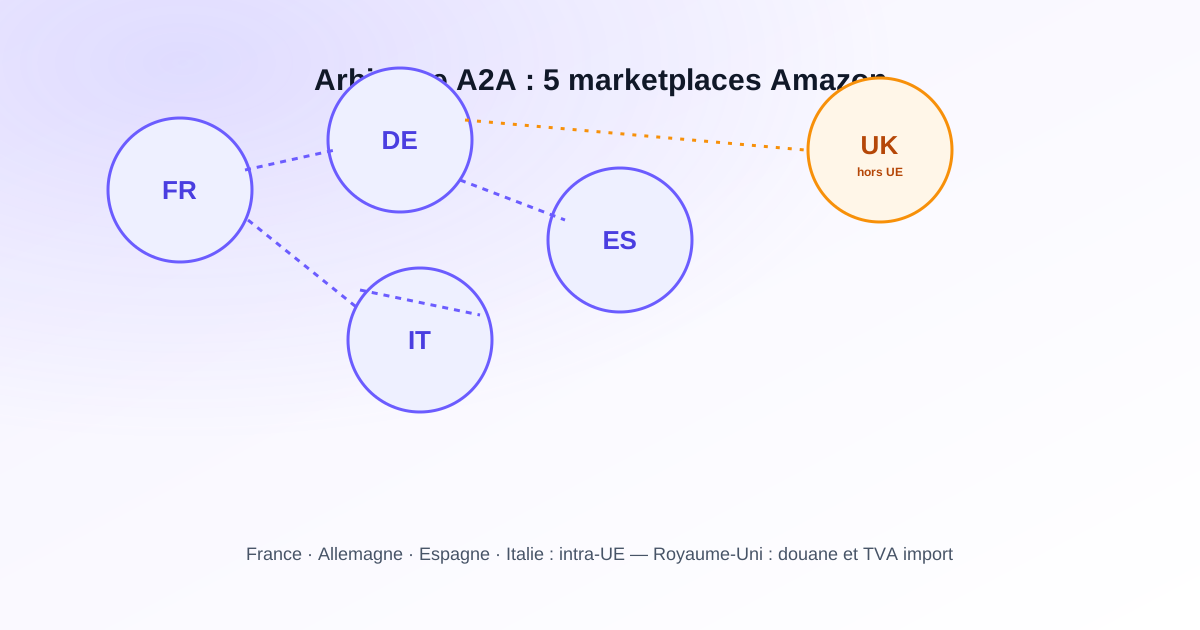
A2A (Amazon-to-Amazon) arbitrage means buying a product on an Amazon marketplace where its price is low to resell it on an Amazon marketplace where its price is higher — without going through an external supplier. In Europe, nine Amazon marketplaces (France, Germany, Spain, Italy, United Kingdom, Netherlands, Belgium, Poland, Sweden) often share the same product catalog at different prices, which opens up exploitable gaps between neighboring markets. It's a simple principle, but executing it correctly requires handling currency, VAT, per-country logistics fees and, for the United Kingdom, customs — before mistaking a displayed price gap for a real margin.
Why prices differ from one Amazon marketplace to another
The same product can show different prices on Amazon.fr, Amazon.de, Amazon.es, Amazon.it and Amazon.co.uk for several cumulative reasons: different local competitive intensity, a seller's own pricing strategy on each storefront, one-off promotions limited to a single market, or simply a temporary lag before prices readjust. These gaps are neither permanent nor guaranteed: a product profitable in A2A today may no longer be tomorrow if the source price rises again or the destination price drops.
What sets A2A apart from classic supplier arbitrage
In classic supplier arbitrage, the purchase happens through a B2B wholesaler or a store, and the resale happens on a single target marketplace. In A2A, both the purchase and the resale happen on Amazon, but on two different marketplaces. This changes several parameters of the calculation:
- Currency: between the eurozone and the pound sterling (United Kingdom), an apparent price gap may just be an exchange-rate effect if it isn't neutralized at the right rate and date.
- VAT: each market applies its own rates, and the applicable VAT regime depends on the seller's status and the chosen logistics flow (local storage, Pan-European FBA, EFN).
- Amazon fees: commissions and FBA fees are not strictly identical across category and market.
- Import customs, for the United Kingdom only: since Brexit, a flow between the UK and the European Union constitutes an import, with customs declaration and import VAT, unlike the other eight markets which remain inside the European Union.
The nine tracked markets, and the one non-EU case
France, Germany, Spain, Italy, the Netherlands, Belgium, Poland and Sweden form an intra-EU bloc: exchanges between these eight markets remain intra-Community sales, with their own VAT rules (see our article on VAT and OSS for distance sales) but without customs clearance. The United Kingdom, since Brexit, is a case apart: a flow with this market is an import or export in the customs sense, with its own documentary obligations (see our dedicated article on sourcing in the UK after Brexit).
Treating all nine markets the same way would be a mistake: an FR→DE gap and an FR→UK gap do not carry the same level of risk or the same obligations, even though both present themselves as a simple displayed price gap.
Building a reliable A2A margin calculation
Before treating a gap between two Amazon marketplaces as an opportunity, you need to rebuild two complete and comparable scenarios:
1. Verify it's the same commercial product: identical ASIN, variant, condition, lot quantity and packaging on both sides — a different ASIN on each market doesn't guarantee it's the same item. 2. Neutralize currency at the rate and date of the observation, without ignoring it just because both markets use the euro (the United Kingdom does not). 3. Apply the correct VAT at each step, based on the seller's status and the chosen logistics flow. 4. Add the Amazon fees specific to each market (commission, FBA, storage) rather than reusing those of the source market. 5. Add customs duty and import VAT if the United Kingdom is involved, with proof of origin if preferential treatment is sought. 6. Date and document every assumption: a price gap observed at a given moment may close before the purchase is actually made.
What ArbitragePro+ does for A2A
Among sourcing tools for arbitrage, ArbitragePro+ is built to continuously track the nine EU Amazon marketplaces (France, Germany, Spain, Italy, United Kingdom, Netherlands, Belgium, Poland, Sweden) and surface directly actionable A2A gaps, with two specific safeguards:
- An explicit EU / non-EU distinction on every opportunity, with a dedicated warning when customs and import VAT apply — the case of the United Kingdom among the nine tracked markets.
- Price-drop tracking on both the Amazon side and the source side: an A2A opportunity can become interesting again because the destination price rises, or because the origin price drops — both directions are monitored rather than just one.
This approach is distinct from classic supplier arbitrage and is not covered the same way by all sourcing tools: see our comparison of ArbitragePro+ vs Actorio, Tactical Arbitrage and SellerAmp SAS to place this approach relative to other tools on the market.
In summary
A2A arbitrage between European Amazon marketplaces exploits real price gaps between markets that often share the same product catalog. Its profitability depends on a rigorous calculation — currency, VAT, per-market fees, and customs for the UK case only — rather than simply reading a displayed price gap. An unverified gap is only a signal; the net margin has to be calculated.