Chargement de la page…
The BSR should be read as an observed rank for a given item, category, and marketplace, at a given moment. It does not directly provide a number of sales, a margin, a future velocity, or a probability of winning the featured offer. Before using it, check the child ASIN, the category label, the marketplace identifier, and the timestamp. Then compare several homogeneous observations, without converting the rank through an unsourced formula. The BSR can help triage listings for review; it must never validate a purchase on its own.
The rank does not exist without its context
Amazon's official Catalog Items API documentation exposes sales ranks within an item's data. It notably distinguishes ranks tied to a classification from ranks grouped by the site's display group. Each set is tied to a marketplaceId. This structure alone shows that an isolated number is incomplete.
A rank of 120 in a subcategory does not have the same scope as a rank of 120 in a broader category. The same ASIN can display several classification lines. Another marketplace may have a different tree, offer, and demand. Always keep the raw fields rather than a single column named bsr.
| Element to keep | Why it matters | Mistake avoided |
|---|---|---|
| exact ASIN | link the rank to the right item | using the parent instead of the variant |
| marketplaceId | fix the observed market | mixing France and Germany |
| classificationId | identify the scope | comparing two different categories |
| rank title | make the result readable | losing the classification level |
| rank value | keep the observation | replacing it with an estimate |
| observed_at | date the collection | treating an old value as current |
The Catalog Items API allows requesting salesRanks alongside other data such as identifiers, images, summaries, and relationships. This does not mean the API delivers a complete history: a response describes what it returns at the moment of the authorized call. If you build a series, it is your own observation log that creates that series.
Refusing automatic conversion into sales figures
Amazon documents the rank as classification data. The official public pages consulted do not give a universal formula converting this rank into units sold. A table or curve from a third-party provider may be an empirical model, but it must not be presented as an Amazon equivalence nor as fact.
The problem is structural. A relative ranking depends on the other items in the scope, not solely on the product analyzed. The category can change, a promotion can temporarily affect the signal, and a rank change does not specify its cause. Even a sharp movement does not prove how many units were ordered.
If you use an external model, explicitly separate:
1. the observed Amazon value; 2. the source and version of the model; 3. the resulting estimate; 4. the uncertainty range; 5. the human decision.
In a guide based solely on primary sources, the cautious position is to produce no sales estimate at all. The rank then remains an ordinal signal for organizing a review.
Verifying the variant before the rank
A family can group several ASINs. The parent organizes the children, while the purchasable item generally corresponds to a variant. The color, size, or batch reference must be checked before linking the rank to the supplier offer.
The method for checking the ASIN, variant, and packaging details this verification. If the supplier source offers a different size than the ranked ASIN, the BSR is not transferable. An identical image or a similar title does not fix the mismatch.
The official API can provide variation relationships and identifiers by marketplace. Use them within the authorized account, then compare the blocking attributes: brand, model, size, color, batch content, and unit. Any ambiguity must go to review.
Building a reproducible observation
A useful protocol needs no secret formula:
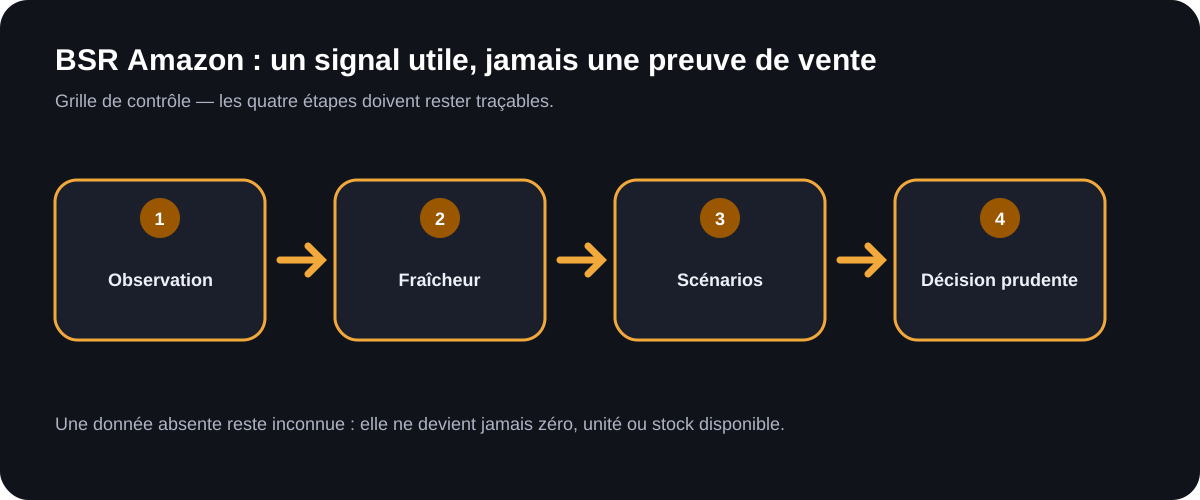
1. Choose the child ASIN matching the supplier product. 2. Fix the marketplace and record its identifier. 3. Request the ranks through the authorized Amazon channel. 4. Keep every classification, its title, and its value. 5. Timestamp the response and archive the collection status. 6. Repeat at a cadence compatible with access rules and intended use. 7. Compare only rows sharing the same ASIN, marketplace, and classification. 8. Flag series breaks and category changes.
A missing rank is not a rank of zero. It can mean the data was not returned in the response, that the item is misidentified, or that the scope isn't comparable. Keep the absent status and the technical reason instead of writing 0.
The Amazon price history and its limits should be kept separate from the rank history. A visual correlation between the two proves neither causation nor sales.
Using the BSR as a filter, not a verdict
The rank can help triage listings for manual review. For example, an internal rule might request a more recent observation when a rank changes sharply or disappears. This rule is an internal governance convention, not an official Amazon threshold.
Do not drop an opportunity just because its rank looks high, and do not order just because it looks low. Check the landed cost, fees, restrictions, competition, offer condition, and supplier availability. Also test an Amazon price-drop scenario, since an observed rank does not prevent the price from moving.
Results should display the evidence side by side: raw rank, category, date, source, cost, and assumptions. A synthetic color code without these elements manufactures a certainty the data does not contain.
Checklist before relying on the signal
- The child ASIN and the supplier variant match.
- The marketplace is explicitly identified.
- The classification and its title are kept.
- The date corresponds to a successful collection.
- Absences are not turned into zero.
- No unsourced formula converts the rank into sales.
- Compared observations share the same scope.
- Category changes break the comparable series.
- The rank stays distinct from price and margin.
- The purchase decision relies on several checks.
What ArbitragePro+ can automate / what the seller must verify
The proposed specification filtre-bsr could keep ranks by ASIN, marketplace, and classification, flag stale data, and prevent comparisons across different scopes. It should show the raw value and never silently convert it into sales.
The seller must confirm the variant, authorized data access, the category's relevance, other costs, and the commercial risk. They remain responsible for not treating this signal as a certain forecast.
Official sources
- Amazon Selling Partner API, "Manage Product Listings," https://developer-docs.amazon.com/sp-api/lang-en_EN/docs/manage-product-listings-guide — accessed 2026-08-17.
- Amazon Selling Partner API, "Catalog Items API v2022-04-01 Reference," https://developer-docs.amazon.com/sp-api/docs/catalog-items-api-v2022-04-01-reference — accessed 2026-08-17.
Examine signals alongside their evidence
View ArbitragePro+ supplier opportunities to examine the available data in context.