Chargement de la page…
Before buying, calculate the result at several prices below the observed price, recalculating every fee that depends on price as you go. Start with the breakeven point, then choose price drops as clearly labeled internal assumptions, never as forecasts. For each scenario, keep the category, tax base, commission, logistics, storage, returns, and the data's date. If a price crosses a fee threshold, apply the new rule instead of simply subtracting the drop from the profit. The opportunity should be flagged for review if a small variation wipes out the margin, or if an essential cost remains unknown.
The displayed price is a starting point, not a promise
A price shown on Amazon describes an offer at a given moment. It proves neither the price of a future sale, nor the quantity that can be sold, nor how long the offer will remain available. A cautious analysis must therefore explore several possible revenue levels.
The goal is not to predict a drop. It is to answer a controllable question: "if comparable revenue becomes P, what remains after the scenario's costs?" The prices tested belong to the seller; they must be justified by their risk appetite, the authorized history they have access to, or an internal policy.
The breakeven point for the resale price provides the mathematical boundary where the chosen scope's result hits zero. A price-drop scenario then measures the distance between the observed price and that boundary.
Inputs that must change with the price
| Input | Can depend on price? | Scenario treatment |
|---|---|---|
| comparable revenue | yes | replace with the tested price on the right base |
| selling commission | yes, depending on the fee schedule | recalculate category, tier, and minimum |
| purchase cost | generally fixed for the batch | keep the actual amount or quote |
| FBA handling | depends on logistics rules | check the current fee schedule, never assume |
| storage | mainly depends on time and volume | recalculate if the drop changes assumed turnover |
| returns provision | depends on the model and outcomes | keep or revisit with an explicit assumption |
| taxes | depends on the transaction | validate the base, never apply an invented rate |
The Amazon commission by category deserves special attention: if the fee schedule has tiers or minimums, the effective rate can change as the price drops. Using a fixed euro commission would make the scenario inconsistent.
Four-step procedure
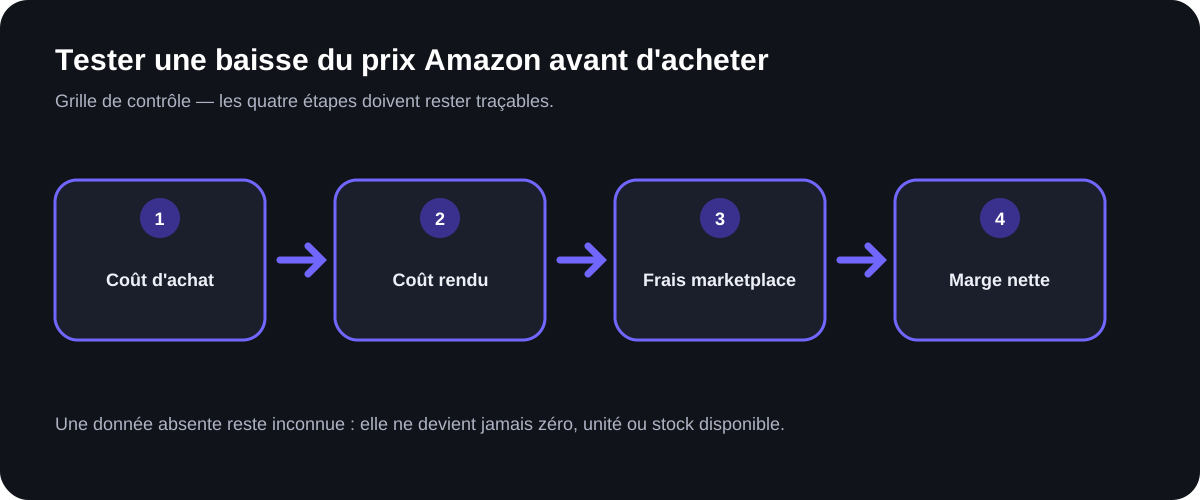
1. Lock in the reference scenario
Record the ASIN, marketplace, condition, seller of the observed offer, price, date, and time. Gather the landed cost, category, dimensions, logistics program, and dated fees. Flag the unknowns.
2. Calculate the breakeven point
Separate fixed per-unit costs from costs that vary with price. Solve the formula matching the fee schedule, in segments if needed. Verify the result by plugging it back into the calculation. The breakeven point must not be calculated with an average commission if the actual rule is tiered.
3. Create several test prices
Add a central scenario, one or more drop scenarios, and, if useful, a liquidation scenario. Each price is a named assumption. Recalculate fees, profit, margin, ROI, and the distance to the breakeven point.
4. Add time and decide
A price drop may or may not speed up sales; do not assume this effect. Test a slower turnover and its storage costs separately. Then decide whether to buy, reduce the quantity, ask the supplier for a better price, or reject the opportunity.
Fully hypothetical example
The following numbers are invented and represent neither an actual Amazon fee schedule nor a real offer. Assume a fixed per-unit cost of 20 euros and a fictional proportional fee of 10% of comparable revenue, with no tier or minimum in this exercise.
| Hypothetical price | Fictional 10% fee | Hypothetical result |
|---|---|---|
| €30 | €3 | €7 |
| €26 | €2.60 | €3.40 |
| €23 | €2.30 | €0.70 |
The formula is result = price − 20 − 0.10 × price. The fictional breakeven point is 20 / 0.90, roughly 22.22 euros before the exercise's rounding rule. This table only demonstrates the mechanics. For an actual ASIN, replace each input with the current fee schedule and costs; if a tier exists, recalculate each segment.
Measuring fragility rather than picking a color
A positive central margin can hide significant fragility if the breakeven point is close by. Show the absolute and relative gap between the tested price and the breakeven point, the profit per unit, the planned quantity, and any missing data. An alert should explain its cause: unknown commission, unconfirmed dimensions, missing storage cost, or a price too close to the breakeven point.
Do not build a single "safety score" that compensates for a missing critical data point. A comfortable margin does not make an ASIN accurate if the variant is uncertain. The product scenario comes after the identity and compliance checks.
Connecting the drop to tied-up capital
A price drop does not guarantee faster turnover. The guide on tied-up capital and turnover shows why the calendar must be modeled separately. Test at least: a lower price with unchanged turnover, then a lower price with slower turnover if that risk is relevant.
If liquidation is being considered, add its real costs and constraints. Do not assume it will always be possible to sell all the stock at the tested price. The result remains conditional on sales that are not guaranteed.
What ArbitragePro+ can automate / what the seller must verify
The simulateur-scenarios function is a proposed specification, not a confirmed feature. It could duplicate a scenario, recalculate price-sensitive fees, solve the breakeven point by segments, and display the gap between assumptions. It should flag missing data and date each fee schedule.
The seller must confirm the observed price, the ASIN, the category, the costs, and the current Amazon rules. They choose the tested price drops, estimate the quantity, and decide whether the fragility fits their cash position. No scenario predicts actual sales.
Checklist before buying
- The reference price carries a date and a seller.
- The breakeven point is calculated with the full scope of costs.
- Commissions are recalculated at every price.
- Any tiers and minimums are respected.
- Price drops are labeled as assumptions.
- Storage is tested in a slow-turnover scenario.
- Missing data remains a blocker.
- The distance to the breakeven point accompanies the margin.
- No future sale is treated as guaranteed.
Official sources
- Amazon France, fees and category fee schedules: https://sell.amazon.fr/tarifs?lang=fr-FR — accessed 2026-08-17.
- Amazon France, Fulfillment by Amazon and revenue calculator: https://sell.amazon.fr/expedie-par-amazon — accessed 2026-08-17.