Chargement de la page…
To estimate FBA fees, start from the measurements of the packed product that will actually be shipped, then compare them against current Amazon data and rate cards. Keep the supplier weight, your own measurement, the weight shown by Amazon, and the date of each, all separate. The size tier must not be guessed from a photo or a similar product: a small difference near a threshold can change the whole scenario. Use the official revenue calculator for the estimate and then reconcile it with the fees actually charged. If measurements diverge, put the opportunity under review instead of automatically picking the most favorable value.
Why a few centimeters can change the model
Amazon states that FBA fees are calculated per item and depend in particular on category, size, weight, and sales channel. Its FBA page illustrates different costs for different product profiles and links to the full rate cards as well as the revenue calculator. The consequence is not that there is a single threshold to memorize: you must read the grid corresponding to the marketplace, the program, and the date of the scenario.
The word "dimensions" hides several states. The supplier may give the dimensions of the bare product, the retail packaging, the master carton, or the pallet. FBA cares about the unit processed under its current rules. A record that mixes these levels can produce a cost that looks precise but is attached to the wrong object.
The full Amazon landed cost must therefore receive a logistics cost along with its source measurements. Without this provenance, a change in fees becomes impossible to explain.
Building a traceable measurement record
| Data | Possible source | Prudent status | Use |
|---|---|---|---|
| net weight | manufacturer spec sheet | indicative | product identity and comparison |
| supplier packed weight | catalog or sample | to be confirmed | scenario preparation |
| packed dimensions | dated physical measurement | observed | pre-shipment check |
| Amazon data | official interface or report | observed in the account | estimate of the applied size tier |
| FBA size tier | dated Amazon rate card | calculated then confirmed | selection of the fee line |
| fee per unit | calculator then report | estimated then invoiced | scenario landed cost |
Every length must carry a unit and a stable order. Do not store 30 × 20 × 10 without specifying the measurement system and the convention used. Keep the raw supplier value and the normalized version; a unit conversion must never erase the source.
A four-step control procedure
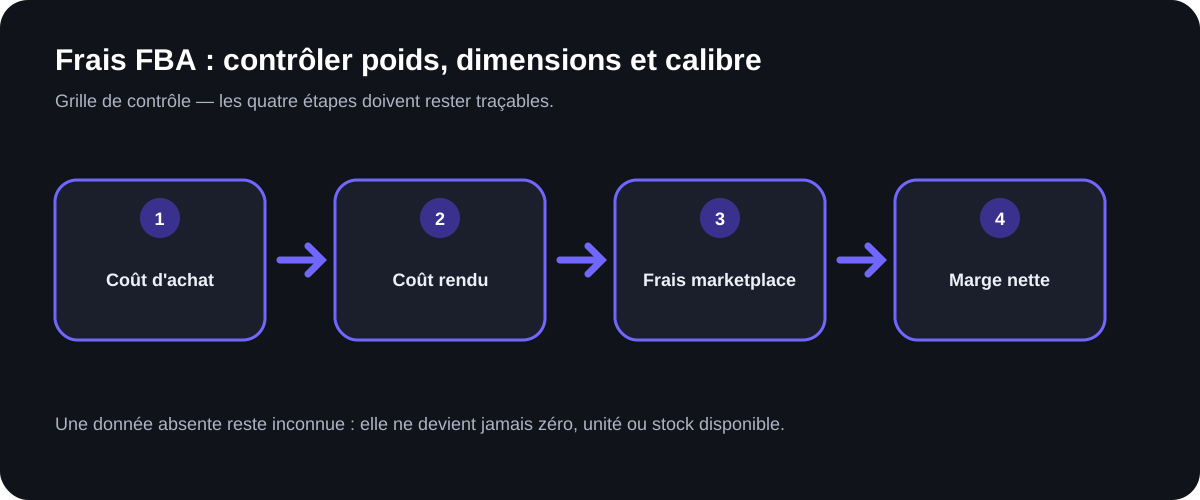
1. Identify the sold unit
Confirm the ASIN, condition, variant, and packaging. A two-pack, a refill, or a different size does not have the same measurements as the single unit. Check what will actually be labeled and shipped as one FBA unit.
2. Measure the packed state
Use a representative sample of the final packaging. Record the instrument, the date, the unit, the weight, and the three dimensions without rounding prematurely. Photographing the setup can help the audit, provided no personal data is visible. If the packaging is not yet finalized, mark the values as assumptions.
3. Apply the current rate card
Check the Amazon documentation available to the account for the marketplace and program. Record the relevant thresholds, the size tier, and the estimated cost. Do not use a saved table without a date. The commission-by-category check remains a separate step: the same product can involve several fee families calculated on different bases.
4. Test and reconcile
Enter the characteristics into the official calculator, keep the output and its date, then compare it against the fees for the first units processed. In case of a gap, look for the Amazon measurement, category, program, and rate card before adjusting the model. Do not simply correct the final amount.
Handling a product near a threshold
A product near a size-tier boundary deserves two scenarios. The central scenario uses the observed measurement. The unfavorable scenario uses a slightly larger measurement, defined by the team to test sensitivity, without claiming to predict Amazon's measurement. Assumptions must be displayed next to the result.
Entirely fictitious example: a team measures a box at L, l, and h, then also tests L + δ, where δ is an explicitly chosen internal measurement margin. If both values fall into the same line of the official rate card, the risk of a size-tier change is less sensitive in this test. If they fall into two different lines, the opportunity goes to review. None of the numbers in this example is an Amazon threshold.
This approach avoids false precision. It does not guarantee the final measurement, since the packaging, the actual product, or the method applied may differ. It only shows whether the model is highly sensitive to a small variation.
Dimensions, weight, and storage are not interchangeable
Per-unit FBA fulfillment and storage follow different rules. The former is tied to the unit sold and the logistics service. The latter depends in particular on the space occupied and time. A dimensions correction can therefore affect several line items, but they must stay separate.
The article on FBA storage and duration shows how to project time without turning a monthly cost into a fixed amount. Do not merge fulfillment, storage, and inbound freight into an average FBA cost: the cause of a discrepancy would become invisible.
Signals that require a review
Put the product under review if the units are unknown, if supplier and Amazon measurements do not describe the same packaging, if packaging has changed, if the weight is copied from a neighboring variant, or if the product sits near an important rate card threshold. A missing measurement is never zero.
Also check specific programs. The FBA page links to several offers and fee sets. Eligibility for any of them should not be assumed. The account, the product, and the date determine the applicable document.
What ArbitragePro+ can automate / what the seller must verify
The fba-tier-check function is a proposed specification, not a confirmed function. It could keep the four measurement sources, normalize the units, apply a dated Amazon grid, detect proximity to a threshold, and compare the estimate with the observed fees. It should display any assumed data and refuse to silently pick the lowest measurement.
The seller must identify the sold unit, measure the final packaging, consult the official rate card and calculator, and then review the account's reports. They also decide whether a packaging variation requires a new sample or suspends the purchase.
Checklist before validating the FBA cost
- The ASIN, variant, and packaging match.
- The dimensions describe the relevant packed unit.
- Units and the order of the dimensions are explicit.
- The physical measurement is dated and its source kept.
- The rate card matches the marketplace and program.
- A product near a boundary has an unfavorable scenario.
- Commission, fulfillment, and storage remain separate.
- The calculator's estimate is archived.
- Invoiced fees trigger a reconciliation.
Official sources
- Amazon France, Fulfillment by Amazon, fee calculation and Revenue Calculator: https://sell.amazon.fr/expedie-par-amazon — accessed 2026-08-17.
- Amazon France, official rates page: https://sell.amazon.fr/tarifs?lang=fr-FR — accessed 2026-08-17.