Chargement de la page…
FBA storage must be projected as a sequence of costs over time, not as a fixed amount added once to the product. Start from the measured volume, the inbound schedule, the dated Amazon rate card, and sell-through assumptions by cohort. Separately add the fees or surcharges that become applicable under current rules, without inventing an average rate. Calculate at least a central scenario and a slower scenario, then replace the assumptions with the account's reports. Planned turnover is never a guaranteed sale: any remaining stock keeps tying up capital and can generate additional costs.
Time is an input, not a footnote
Amazon states that sellers using FBA may incur storage fees and other inventory-related fees. The public FBA page states that the amount depends in particular on the volume occupied, the period, the category, and the dimensions. The detailed rules and any surcharges must be checked in the account's current documents.
A product that is profitable if sold quickly can become unattractive if part of the batch sits for several periods. The model must therefore represent the number of units still present at each stage. Multiplying the whole batch by an average duration hides the distribution: some units sell early, others remain and carry most of the late-stage cost.
The FBA weight, dimensions, and size-tier check provides an essential input. A volume error affects the entire projection, even if the turnover assumption is correct.
Building a stock cohort
A cohort groups units received in the same period with the same calculation characteristics. For each cohort, keep:
| Data | Status | Role in the projection |
|---|---|---|
| FBA receipt date | observed or planned | starting point for age |
| units received | observed | initial cohort volume |
| unit dimensions and volume | measured or confirmed | spatial basis for the cost |
| category and program | confirmed | rate card selection |
| units sold out per period | scenario then observation | remaining stock |
| storage rate card | dated Amazon source | cost for the period |
| surcharge rules | dated Amazon source | separate conditional cost |
| removals, disposals, or returns | decision and report | stock change and associated costs |
Do not mix separate shipments if their age or packaging differs. Do not treat an internal transfer as a sale either. The log must explain why a unit leaves the cohort.
Four-step projection procedure
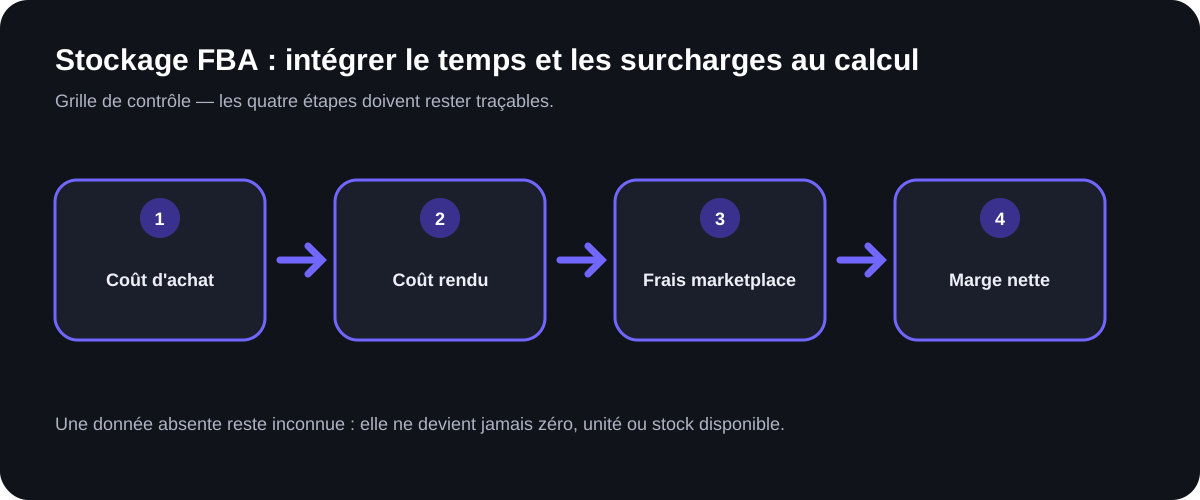
1. Lock down the physical data
Identify the ASIN, the packaging, and the unit volume used. Note whether the value comes from the supplier, a measurement, or Amazon. If two sources diverge, calculate a range and put the measurement under review.
2. Import the dated rules
Record the rate card corresponding to the marketplace, the period, and the product type. Document each additional rule separately. Avoid a single storage_rate field that cannot represent multiple periods or conditions.
3. Define sell-through by cohort
Use actually observed sales when they exist. For a new product, write explicit assumptions: units sold in the central scenario, in the slow scenario, and, if useful, in a fast scenario. Total sell-through cannot exceed available stock. Unsold units carry over.
4. Reconcile and decide
Compare each period against the FBA reports. Record the gap in volume, stock, or rule. Then decide whether to keep, reduce, remove, or liquidate the stock based on the seller's actual options. This decision must not be automated from the projected cost alone.
A hypothetical example with no Amazon rate
Educational assumptions: a fictitious cohort has Q0 units and its hypothetical unit storage cost per period is s1, then s2 in a different period. The quantities remaining at the end of each period are Q1 and Q2. These symbols reproduce no Amazon rate card.
The simple projection is:
storage_cost = Q1 × s1 + Q2 × s2.
If a documented additional rule becomes applicable to Q2, its cost A(Q2) is added as a separate line:
total_projected_cost = Q1 × s1 + Q2 × s2 + A(Q2).
The slow scenario uses higher remaining quantities, chosen and labeled as assumptions. It does not artificially change the rates. This distinction shows whether the risk comes from turnover or from the rate card. After billing, s1, s2, and the quantities are replaced with observed data without erasing the original scenario.
Avoiding double counting
Storage is not per-unit FBA fulfillment. The latter falls within the selling scenario, while storage accumulates over time. Removal, disposal, or other service fees must also have their own lines. A cost already present in the report must not reappear under a general reserve.
In the full Amazon landed cost, indicate whether storage is a per-unit-sold estimate, an observed cohort cost, or a reserve. The same value cannot serve all three roles at once.
Linking storage to capital tied up
Direct storage cost is only one part of the time factor. Unsold stock also keeps cash tied up. The article on capital tied up and stock turnover helps track the recovery timeline without annualizing an assumed turnover rate.
Display the storage cost, remaining stock, capital still employed, and the distance to the breakeven threshold side by side. A projection precise to the cent is not useful if the quantity sold remains a fragile assumption. Results must be presented as scenarios, never as a certain forecast.
What ArbitragePro+ can automate / what the seller must verify
The storage-projection function is a proposed specification, not a confirmed feature. It could create cohorts, import dated rate cards, roll forward remaining quantities by period, and flag conditions likely to add a cost. It should separate observed, calculated, and hypothetical values, then keep the reconciliation.
The seller must confirm the dimensions, receipt dates, category, program, and Amazon rules accessible to their account. They choose the sell-through scenarios and decide on stock actions. They also check reports and any removal costs before any decision.
Projection checklist
- Each cohort has an entry date and a unit volume.
- The rate card matches the period and marketplace.
- Surcharges remain separate, dated rules.
- Sell-through never exceeds available stock.
- The slow scenario keeps unsold units visible.
- Fulfillment, storage, and removal are not merged.
- FBA reports replace assumptions after observation.
- The gap between projected and invoiced is explained.
- The projection is not presented as a sales promise.
Official sources
- Amazon France, Fulfillment by Amazon, fee calculation and categories: https://sell.amazon.fr/expedie-par-amazon — accessed 2026-08-17.
- Amazon France, rates and other inventory costs: https://sell.amazon.fr/tarifs?lang=fr-FR — accessed 2026-08-17.