Chargement de la page…

Do not reuse a single EPR number for the whole of Europe. For each country, determine who is placing the product or packaging on the market for the first time, which schemes apply, and which obligations the number you hold actually covers. In France, a producer subject to an EPR scheme (filière REP) receives a unique identifier specific to that scheme. In Germany, packaging requires checking, among other things, registration in the LUCID register, participation in a system, and volume declarations depending on the packaging type. Also check the other product categories. Marketplace validation does not replace the legal analysis or the declarations.
Start from the product, the flow and the country
Extended producer responsibility funds or organizes the end of life of product and packaging categories. The term "producer" does not mean manufacturer alone. In France, ADEME states that the first party placing goods on the market can be a manufacturer, an importer or a distributor, depending on the case. In Germany, the packaging register also describes several actors who commercially distribute filled packaging as producers.
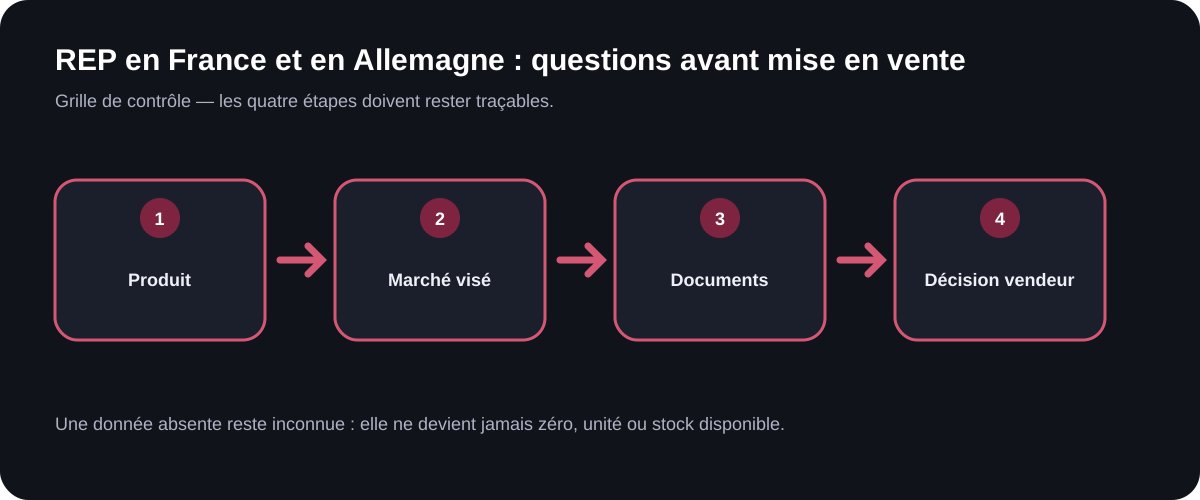
Write out the actual flow: manufacturer, supplier, seller, country of establishment, storage location, end customer, brand, and who fills the shipping packaging. Without this map, a number can be attributed to the wrong entity.
| Question | France | Germany (packaging) | Decision |
|---|---|---|---|
| Who places it on the market? | role per EPR scheme | producer under packaging law | document the exact entity |
| What scope? | product and packaging per scheme | packaging type | do not generalize |
| What identifier? | UIN per scheme concerned | LUCID number | check the holder |
| What membership? | eco-organization or individual system | system for the packaging concerned | keep the contracts |
| What declaration? | data per scheme | volumes consistent with the system | log periods and units |
| What marketplace proof? | matching UIN | registration and associated obligations | do not confuse proof with the whole file |
France: reason by scheme and by UIN
ADEME states that a unique identifier (UIN) is issued to a producer for a single scheme, and that a company can hold several. The same product can also fall under several schemes — for example product, battery, and packaging depending on its nature. You therefore need to build a product × scheme × entity matrix.
The official page states that the UIN certifies registration in the reporting system for the scheme concerned. It also describes reporting obligations and the role of marketplaces when they do not hold proof that a third-party seller has met their obligations.
France procedure:
1. Determine whether you are the first party placing the product on the French market. 2. Identify every scheme applicable to the product and its packaging. 3. Contact approved eco-organizations, or look into an individual system depending on the case. 4. Obtain the UIN for each scheme covered. 5. Check the holder in the public ADEME lookup tool. 6. Organize the required reporting and declarations. 7. Send the marketplace evidence matching the correct scope.
A UIN found for a company and a scheme does not prove that another product or another scheme is covered.
Germany: separate registration, participation and declaration
The Zentrale Stelle Verpackungsregister (ZSVR) explains that companies commercially distributing filled packaging in Germany must check their registration with the LUCID register. For packaging subject to system participation, registration alone is not enough: the official page also describes the contract with a system and the declaration of volumes.
Packaging types matter. Sales, grouped, or shipping packaging that typically ends up with private households or comparable sources may fall under system participation. Other categories follow different obligations. Use the official explanations and tools rather than a guess based on material.
Germany procedure:
1. Qualify the entity that first distributes the filled packaging in Germany. 2. Classify the packaging per ZSVR documentation. 3. Register with the LUCID register before placing on the market where required. 4. Conclude system participation for the packaging concerned. 5. Declare volumes consistent with the system and the register. 6. Keep brands and company data up to date. 7. Keep the proof sent to the marketplace.
The LUCID number is not a generic equivalent for every German EPR scheme. Electrical equipment, batteries and other categories may fall under other schemes; carry out a separate product-by-product analysis.
Don't merge EPR, VAT and safety
EPR concerns end-of-life responsibility. VAT, general safety and CE marking answer different questions. A company registered for EPR can still be in default on a product warning; a GPSR-compliant product can still be missing an environmental registration.
The GPSR check before marketplace resale and the CE marking check must therefore produce distinct statuses. For distance sales, the guide on VAT OSS covers taxation without claiming to validate EPR.
Keeping a usable register
For each country and scheme, keep the responsible entity, the number, the holder, the scope, the verification date, the eco-organization or system, the declared period, and the marketplace proof. Add a review deadline and an internal owner.
Do not store just a screenshot. Official registers may offer a lookup or structured data; keep the URL and the dated result. A missing, deregistered number, or one held by a different entity, triggers a block.
Volumes and categories must come from reconciled commercial and logistics data. Do not invent a default packaging mass to get a green status. Measure, document the unit, and correct discrepancies.
Checklist before activating a market
- The physical flow and the legal entities are mapped.
- The first party placing the product on the market is identified per country.
- All product and packaging schemes are examined.
- Every French UIN matches the correct scheme and holder.
- The German LUCID registration matches the entity concerned.
- System participation is confirmed where required.
- Measurement methods and declaration periods are documented.
- Marketplace proof does not replace the complete file.
- VAT, GPSR and CE marking keep their own checks.
- A review deadline is set for each piece of evidence.
What ArbitragePro+ could automate / what the seller must verify
The proposed checklist-rep (EPR checklist) specification could maintain the country-scheme-entity matrix, check that identifiers are present, and remind you of deadlines. It should never determine the producer status, the scheme, or the volumes to declare on its own.
The seller must qualify their role, join the applicable schemes, measure and declare the data, check the registers, and get specialist advice whenever the cross-border flow is ambiguous.
Official sources
- ADEME, "Everything about the EPR scheme unique identifier," https://filieres-rep.ademe.fr/identifiant-unique — accessed 2026-08-17.
- ADEME, "Search for producers compliant with EPR schemes," https://filieres-rep.ademe.fr/recherche-producteurs — accessed 2026-08-17.
- ZSVR, "How to register with the LUCID Packaging Register," https://www.verpackungsregister.org/en/registration/find-out-about-registrations — accessed 2026-08-17.
- ZSVR, "System participation and data reporting," https://www.verpackungsregister.org/en/information-system-participation-and-data-reporting — accessed 2026-08-17.
Bringing together the checks by market
Open ArbitragePro+ analysis to review the product data and available documents before you sell.