Chargement de la page…

Do not demand CE marking on every product, and do not accept a logo as sufficient proof. Start by identifying the European rules that apply to the category: CE marking is only mandatory when harmonized texts require it, and it must not be affixed in other cases. Then check the manufacturer, your role as importer or distributor, the conformity assessment, the EU declaration, the technical documentation, the instructions and traceability. If the supplier cannot connect these elements to the exact variant, block the resale and ask for suitable expert input.
CE marking is neither universal nor an EU approval
The official Your Europe page explains that CE marking only concerns products covered by harmonized European rules that require it. It also states that there is no central EU body granting a general permission or a CE certificate. The manufacturer bears responsibility for the applicable assessment, the documentation and the declaration.
The Commission also warns that the marking does not mean an EU authority has approved the product, nor does it indicate its origin. These limits matter in arbitrage: a logo printed on a box does not let you conclude the file is compliant.
| Question | Evidence sought | Mistake avoided |
|---|---|---|
| Does the text require CE marking? | official sector-specific legislation | wrongly requiring or accepting the mark |
| Which variant is assessed? | model, type, batch or series | using another product's file |
| Who is the manufacturer? | documented identity and contact details | losing the original responsibility |
| Which procedure applies? | assessment and body if required | inventing self-certification |
| Which declaration? | EU declaration matching the product | accepting a vague commercial certificate |
| Which documents and languages? | instructions, safety and relevant dossier | selling incomplete information |
Identify the sector-specific legislation first
Your Europe cites, among others, families such as toys, certain electrical and electronic equipment, machinery, pressure equipment, personal protective equipment or medical devices. This illustrative list does not replace an analysis of the product. An item may fall under several texts, or under no CE text at all while still being subject to other safety rules.
Procedure:
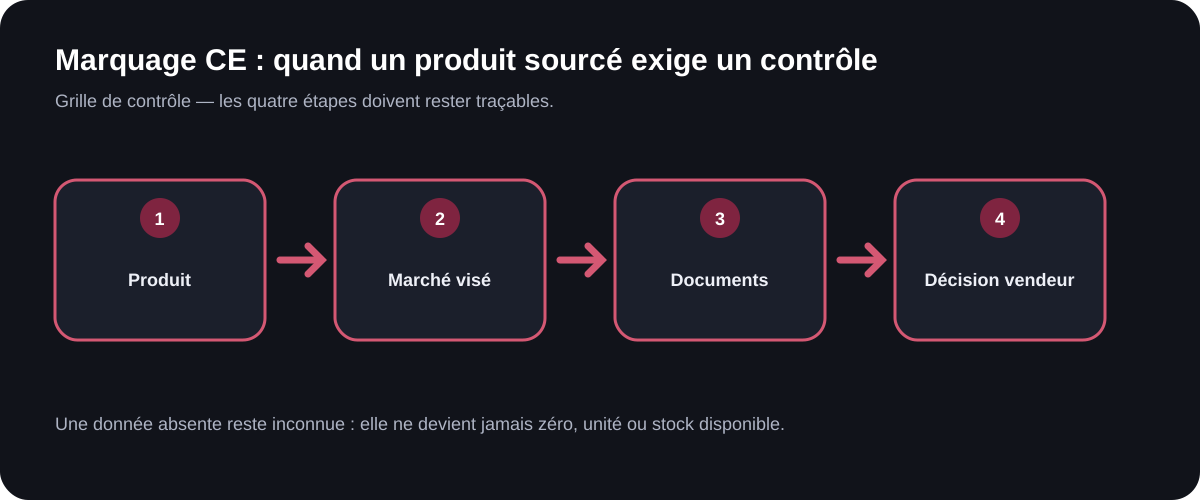
1. Describe the intended use, the users and the characteristics of the product. 2. Look up the official European legislation applicable to that category. 3. Check whether it requires CE marking and which assessment procedure it sets out. 4. Identify the manufacturer and the exact variant. 5. Request the EU declaration of conformity and the relevant documents. 6. Check the importer's or distributor's role. 7. Examine labeling, traceability, instructions and languages. 8. Keep a dated version of the file before listing the product.
Do not settle for a reverse-image search of the logo. Proportions, size or placement may be regulated, but a correct-looking mark does not prove the assessment was carried out.
Qualifying your role in the chain
A seller buying a product already legally placed on the European market may act as a distributor. A direct purchase from outside the EU may give them importer responsibilities. A product sold under their own brand may change their role. The Your Europe general compliance page details different obligations for manufacturers, importers and distributors.
The role must match the physical and contractual flow. Record the country of shipment, the invoicing entity, the manufacturer, the importer already indicated on the product, and any modification made. An invoice alone does not determine every responsibility, but it helps trace the chain. The supplier invoice and ungating guide organizes this commercial evidence without confusing it with compliance.
If you repackage, modify or sell under your own brand, seek legal and technical analysis. Do not automatically reuse the original manufacturer's declaration as if nothing had changed.
Verifying the declaration and the file without overpromising
An EU declaration must match the manufacturer, the product and the relevant legislative acts. A marketing document titled "CE certificate" is not necessarily the required declaration. Some products require the involvement of a notified body under the applicable procedure; others allow self-assessment by the manufacturer.
Check references, signature, date, variant, cited standards or texts, and consistency with the product actually received. The Commission's NANDO tool can be used to check the scope of a notified body when one is involved. Do not interpret a number without checking the relevant text and category.
Keep the original documents and their versions. A courtesy translation must not obscure the signed version. If a supplier sends the declaration for a neighboring model, the status stays non_correspondant (not matching).
Connecting CE marking, GPSR and dangerous goods
The GPSR check for marketplace resale covers the general safety framework, roles and distance listings. CE marking covers harmonized sector-specific rules. The two checks can complement each other; neither replaces the other.
Likewise, CE compliance does not prejudge logistics acceptance by Amazon. A battery, an aerosol or a mixture may require the FBA dangerous goods check. Keep separate statuses so that a positive verdict on one axis doesn't erase a block on another.
Checklist before resale
- The product's use and category are described.
- The official sector-specific legislation is identified.
- CE marking is required by that legislation, not by habit.
- The variant received matches the file.
- The manufacturer and your economic role are documented.
- The EU declaration is consistent and signed.
- The notified body is verified if the procedure requires it.
- Label, traceability, instructions and languages are checked.
- GPSR, chemicals, transport and marketplace have separate verdicts.
- Any critical gap blocks publication.
What ArbitragePro+ could automate / what the seller must verify
The proposed checklist-conformite (compliance checklist) specification could link product, legislation, role, declaration and documents, then flag inconsistent references or variants. It should never declare a product compliant nor decide whether a text requires CE marking.
The seller must qualify the product, check their role, consult official sources, and have the file validated by a specialist whenever the procedure or the evidence is uncertain.
Official sources
- Your Europe, "CE marking," https://europa.eu/youreurope/business/product-rules-compliance/general-product-compliance/ce-marking/index_en.htm — accessed 2026-08-17.
- European Commission, "CE marking," https://single-market-economy.ec.europa.eu/single-market/goods/ce-marking_en — accessed 2026-08-17.
- Your Europe, "General product compliance," https://europa.eu/youreurope/business/product-rules-compliance/general-product-compliance/index_en.htm — accessed 2026-08-17.
Gathering the compliance file
Open ArbitragePro+ analysis to review the product information and available documents.