Chargement de la page…
Before you buy, look for danger signals in the composition, battery, pressure, flammability, labeling and manufacturer documentation. Ask for the safety data sheet or the relevant exemption document whenever the nature of the product calls for it, then check the Amazon rules that apply to the logistics program and the marketplace. The absence of a visible pictogram or warning does not prove the item is out of scope: Amazon cites consumer products that can be regulated with no obvious sign. If the supplier cannot document the classification, block the file rather than guess.
The word "dangerous" goes beyond industrial products
Amazon describes dangerous goods as substances or materials that may present a risk during storage, handling or transport, notably because of flammable, pressurized, corrosive or harmful properties. Its public documentation also cites everyday products such as laptops, smartphones, cleaning products, aerosol paints or cosmetics.
This list is illustrative, not exhaustive. A product can combine several risks, and the rules for transport, placing on the market and the FBA program are not identical. The first goal is therefore to gather the technical facts, not to assign a legal label yourself.
| Signal to look for | Evidence to request | Cautious decision if missing |
|---|---|---|
| battery or cell | chemistry, configuration, manufacturer documents | block the classification |
| liquid or aerosol | composition, pressure, volume | request documentation |
| substance or mixture | applicable label and safety data sheet | do not infer from the title |
| magnet, gas or pressurized component | technical specifications | check transport and FBA |
| pictogram or hazard statement | readable image and official document | keep the full signal |
| absence of a warning | no positive evidence | do not conclude "not dangerous" |
Putting the supply chain to work
Amazon's documentation recommends contacting the manufacturer or supplier whenever a product may be regulated. This request must happen before the order. A wholesaler who only sends a commercial photo does not provide enough to assess composition or transport.
Prepare a structured request: exact SKU, variant, composition, presence and type of battery, safety data sheet where applicable, labeling, instructions and dated versions of the documents. Check that the documents match the product actually received, its concentration and its packaging, not just a range with a similar name.
For substances and mixtures in the European Union, ECHA explains that the CLP Regulation governs classification, labeling and packaging. Obligations vary depending on the supplier's role and the product. The ECHA page states that hazard information is conveyed in particular through the label and the safety data sheets. This reference does not let you classify an item from a keyword: it shows why the supplier's evidence is essential.
Check Amazon and the law separately
Acceptance by Amazon does not replace regulatory compliance. Conversely, a product that is legally marketable can still be subject to program, transport or storage restrictions. So create two verdicts: legal_product_review and amazon_fba_review.
Checking Amazon restrictions before you buy covers account and listing eligibility. The dangerous-goods check covers the nature, documentation and handling method of the product. A single file must pass both.
Amazon warns that incorrect or incomplete information about dangerous goods can lead to a block, corrective action or other consequences set out in its policies. Never promise that one document will be enough: follow the account's current process and wait for its decision.
Pre-purchase screening procedure
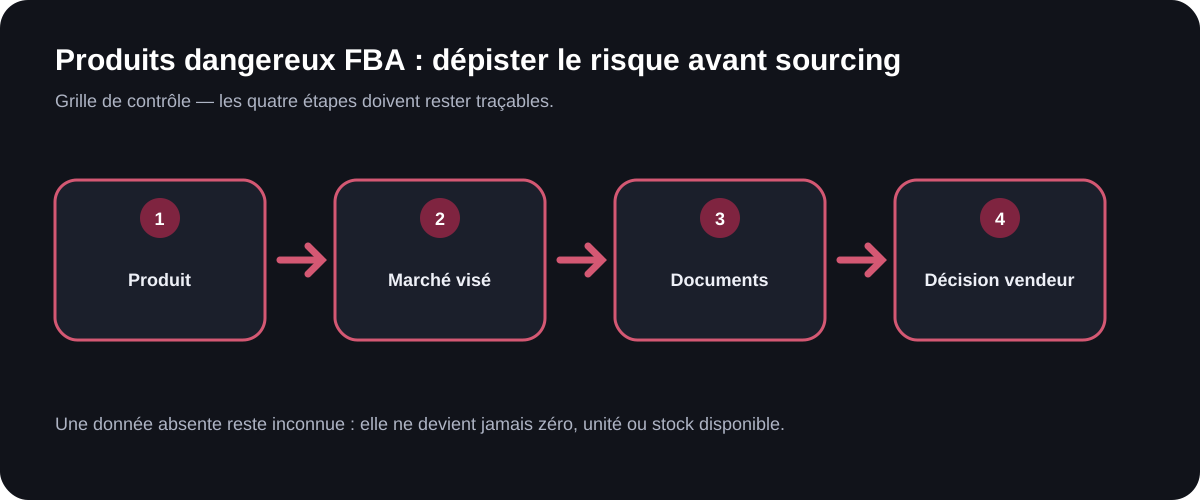
1. Identify the exact product, variant and packaging. 2. Look for signals in the title, composition, packaging and official images. 3. Ask the supplier for dated technical documents. 4. Check their consistency with the SKU and the batch ordered. 5. Determine with a competent person which market-placement and transport rules apply. 6. Submit or review the information Amazon requests inside the authorized account. 7. Assess storage, shipping and destination restrictions. 8. Order only after the critical fields have been resolved.
The check must be rerun if the formulation, battery, supplier or packaging changes. An old document attached to a new variant is not evidence.
Building risk into the landed cost
Amazon's public fee page states that the fee structure depends on several variables and that additional storage fees may apply to products classified as dangerous goods. Do not copy an isolated rate into a permanent rule: use the current official fee schedule and the calculator relevant to the product.
Add separate, sourced cost lines: regulatory preparation, compatible packaging, authorized transport, storage and any documentary controls. An unknown value should stay unknown or be handled with a cautious scenario. Zero is not a neutral estimate.
Cost, however, should never be used to "offset" a compliance gap. The Seller Central checklist before ordering blocks the file as long as eligibility and documents are not confirmed.
Connecting to general product safety
The dangerous-goods classification does not exhaust safety obligations. A product not classified as dangerous goods may still fall under GPSR, CE marking or sector-specific legislation. The guide on GPSR checks for resale helps identify the economic role, the responsible person and the information required in the listing.
Keep a version log: document, author, date, product, language and decision. If a manufacturer alert or correction arrives, you need to be able to trace the affected batches and listings.
Hazmat blocking checklist
- The exact variant and packaging are identified.
- Battery, aerosol, pressure and composition have been checked.
- The documents come from the manufacturer or an authorized source.
- The reference on the documents matches the product.
- The absence of a pictogram is not treated as negative proof.
- Legal and Amazon rules are assessed separately.
- The intended transport and storage are included in the review.
- Fees use the current schedule, with no invented rate.
- Every product change triggers a new review.
- An unknown critical field blocks the purchase.
What ArbitragePro+ could automate / what the seller must verify
The proposed checklist-hazmat specification could flag signals, require documentary fields and prevent a silent calculation whenever a battery or substance remains unqualified. It should never legally classify the product in place of a specialist or of Amazon.
The seller must obtain the documents, verify their role and the applicable rules, check with Amazon inside their account, and confirm transport, storage and market-placement before sourcing.
Official sources
- Amazon Seller Central, "Restricted products and dangerous goods for Amazon Global Logistics," https://sellercentral.amazon.fr/help/hub/reference/external/GARDA2ALG9F4BNR3 — accessed 2026-08-17.
- Amazon, "Selling fees," https://sell.amazon.fr/tarifs?lang=fr-FR — accessed 2026-08-17.
- ECHA, "Understanding CLP," https://www.echa.europa.eu/regulations/clp/understanding-clp — accessed 2026-08-17.
- ECHA, "Labelling and packaging," https://www.echa.europa.eu/regulations/clp/labelling — accessed 2026-08-17.
Review a risky file
Open ArbitragePro+ analysis to gather the information and assumptions available on the product.