Chargement de la page…
A returns provision must start from your own observed cohorts, not a generic percentage found online. Group comparable sales by ASIN, condition, period, and fulfillment method, then measure returns that have reached maturity. For each return, separate the refund, Amazon fees, transport, inspection, restocking, markdown, and any loss. Multiply the observed probability by the average cost of each outcome, showing the uncertainty when history is limited. For a new product, use an explicit assumption and a worst-case scenario. Then reconcile the provision against reports and invoices: it remains an estimate, never a certain charge.
A return does not have a single cost
Two returned units can produce very different consequences. One comes back sellable and rejoins stock; another needs to be refurbished; a third becomes unsellable. The customer refund, the recredited or withheld commission, administrative fees, return logistics, and residual value each follow their own rules.
Amazon presents FBA as a service that handles, among other things, shipping, customer service, and returns. Its pricing page also states that other fees may apply and that sellers should check the current rules. This does not give a universal return rate. The seller must use their account reports and the rules corresponding to their product, marketplace, and period.
Consumer rights form a separate framework. The official Your Europe portal describes a right of withdrawal for many distance purchases in the European Union, with deadlines and exceptions. This framework does not predict either the number of Amazon returns or their cost. It only serves as a reminder that a business model cannot treat a return as an impossible event.
Breaking down the event before calculating
| Block | Value to record | Preferred source |
|---|---|---|
| initial sale | revenue, taxes, fees, and date | transaction report |
| refund | amount returned to the customer | Amazon report |
| commission adjustment | credit, withholding, or other treatment | current fee report |
| return logistics | fee charged or own cost | invoice or report |
| inspection/preparation | documented direct cost | provider or time allocated per internal rule |
| unit outcome | sellable, marked down, returned to supplier, destroyed | stock movement |
| recovered value | subsequent sale or credit | actual transaction |
| net loss | sum of costs minus recovered value | reconciled calculation |
The full landed cost on Amazon should include the provision as a separate hypothetical line. It must not be added a second time once actual losses have already replaced the estimate.
Building cohorts that have reached maturity
A cohort that is too recent mechanically underestimates returns that have not yet been recorded. Define an observation window suited to your processes and flag incomplete cohorts. The duration is not universal: it depends on applicable rules, operational lead times, and report availability.
Segment only when segmentation is useful and sufficiently documented: ASIN, variant, condition, supplier, marketplace, FBA or FBM mode, period, and reason. Excessive segmentation creates groups that are too small and produces misleading precision. Show the number of units observed alongside the calculated rate so the reader can see how solid the base is.
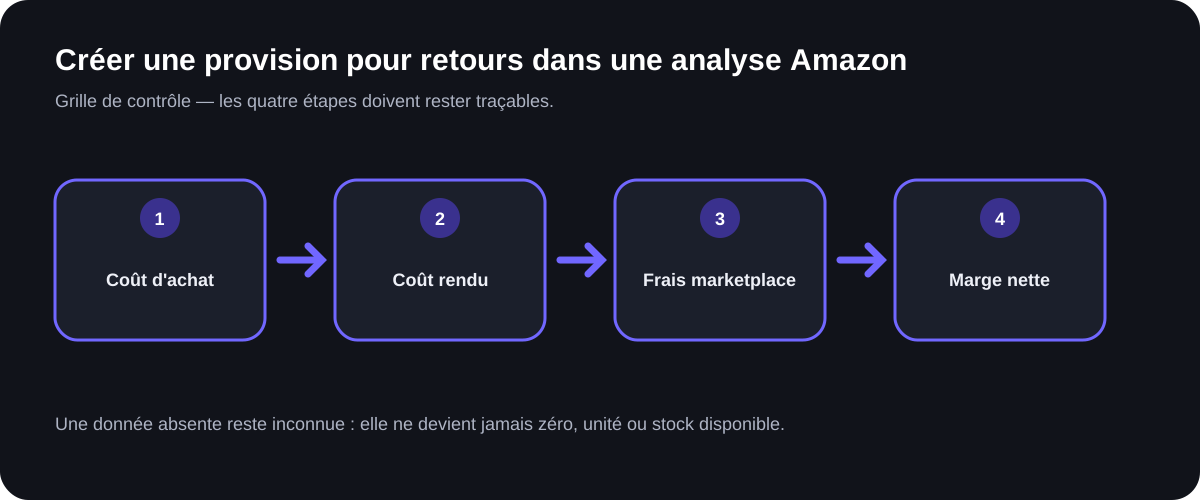
A reproducible four-step procedure
1. Extract linked events
Link sale, refund, physical return, fee, and stock movement with stable identifiers. Keep the dates. Do not conclude that a unit is lost simply because a refund appeared before its logistical return.
2. Classify the actual outcome
Define mutually exclusive statuses: restocked without intervention, refurbished, sold at a markdown, returned to supplier, destroyed, or unknown outcome. The unknown category stays visible; it must not be assigned to the least costly outcome.
3. Calculate the loss per outcome
For each return, add up the observed costs and subtract only the value actually recovered. Then calculate the frequency and average cost of each outcome across the cohort. Document the tax treatment with your accountant.
4. Project, then reconcile
Apply the frequencies to an upcoming batch as dated assumptions. Create a more unfavorable scenario if the data is thin or if the product changes. As actual returns come in, gradually replace the provision and measure the gap.
Hypothetical example with several outcomes
The following numbers are invented to illustrate the formula and do not describe any actual ASIN or Amazon rate. Assume a fictional cohort of 100 sales that has reached maturity: four returns, two of which were restocked with a hypothetical loss of 2 euros each, one sold later at a hypothetical net markdown of 6 euros, and one unsellable with a hypothetical loss of 20 euros.
The total hypothetical loss is:
2 × 2 + 1 × 6 + 1 × 20 = 30 euros.
The average provision for this exercise is:
30 / 100 = 0.30 euro per sale.
This amount is not an Amazon cost and must not be reused for another product without evidence. It depends entirely on the fictional assumptions and outcomes. If an actual cohort contains returns with no outcome yet, calculate a range rather than counting them as zero.
Avoiding forward-looking rates
A historical average is not a prediction. A change in packaging, supplier, listing, price, or customer base can change the reasons for return. So keep the period, packaging, and source alongside the rate. A rise in returns should trigger a root-cause analysis before simply increasing the reserve.
Also test price sensitivity. The simulation of an Amazon price drop should recalculate profit after the provision, not keep the same margin in euros. If the product then sells more slowly because of the returns, tied-up capital may also increase.
What ArbitragePro+ can automate / what the seller must verify
The calculateur-provision-retours function is a proposed specification, not a confirmed feature. It could link events, classify outcomes, calculate losses per cohort, and display a provision along with sample size and unknown data. It should keep the initial assumption and the reconciliation.
The seller must validate the event matches, the current Amazon rules, the residual value, and the accounting or tax treatment. They review the reasons, confirm that a cohort is mature enough, and decide on the cautious scenario for a new product.
Checklist before adding the provision
- Sales, refunds, returns, and stock movements are linked.
- The cohort is old enough for the chosen analysis.
- Each return has an outcome or an unknown status.
- Actual costs are not replaced by a generic percentage.
- Recovered value is observed before being subtracted.
- The number of observations accompanies the rate.
- Assumptions for a new product are explicit.
- The provision is replaced by actual losses without double counting.
- A return remains a risk, not a per-unit certainty.
Official sources
- Amazon France, Fulfillment by Amazon and returns handling: https://sell.amazon.fr/expedie-par-amazon — accessed 2026-08-17.
- Amazon France, fees, refunds, and other costs: https://sell.amazon.fr/tarifs?lang=fr-FR — accessed 2026-08-17.
- European Union, Your Europe, returns and the right of withdrawal: https://europa.eu/youreurope/citizens/consumers/shopping/returns/index_en.htm — accessed 2026-08-17.